
part 2
The TYP at U of T
The Transitional Year Program at the University of Toronto was founded in 1969-1970 to “give economically and educationally disadvantaged students a chance at university education.” The multiracial program emerged out of Black community initiative, but came under attack throughout the late 1970s, following a 1976 review of the program called its reported curricular focus on black studies into question. The story of the TYP thus emerges as a chapter in the struggle for Black Studies at the university. It highlights how Black Studies is related to the educational experiences of Black learners, as well as access to education for all students; and how the demand for accountability to Black communities and involvement of community members in educational governance is perceived as a threat to university administrators. This story of the TYP is one of coalitional struggle—involving educators, students, and local Black community members—to save this program dedicated to expanding access to university education.
BLACK STUDENTS’ ANALYSIS
The scope of reporting about the suspension of the TYP is generally contained to the parameters of the university and its procedures, although given the TYP’s origins in Black community and how assertions about Black students and community members were central in the discourse surrounding its suspension, readers might expect that The Varsity would have prioritized perspectives and experiences of Black people, and of students, teachers and community members directly involved in the program. We also find no clear visual representations of Black people or activities at the TYP accompanying the articles about the TYP published between March 1976 and March 1978. Most are published without accompanying images. Photographs that do appear, feature people holding institutional titles who do not appear to be Black or directly involved with the TYP: SAC President Shirley French (20 September 1976), Phyllis Jensen, graduate student representative on Governing Council (27 October 1976), Father John Kelly, head of the task force (November 8, and November 12, 1976) and SAC university government commissioner Brian O’Riordan (15 November 1976). Notably, when the task force held it’s only open public meeting on the subject as reported in the November 10th 1976 issue of the Varsity, “The Transitional Year Program received whole-hearted support from the Ontario Anti-Poverty Organization, the Native Canadian Center, and Duncan Green, director of the Toronto Board of Education.”
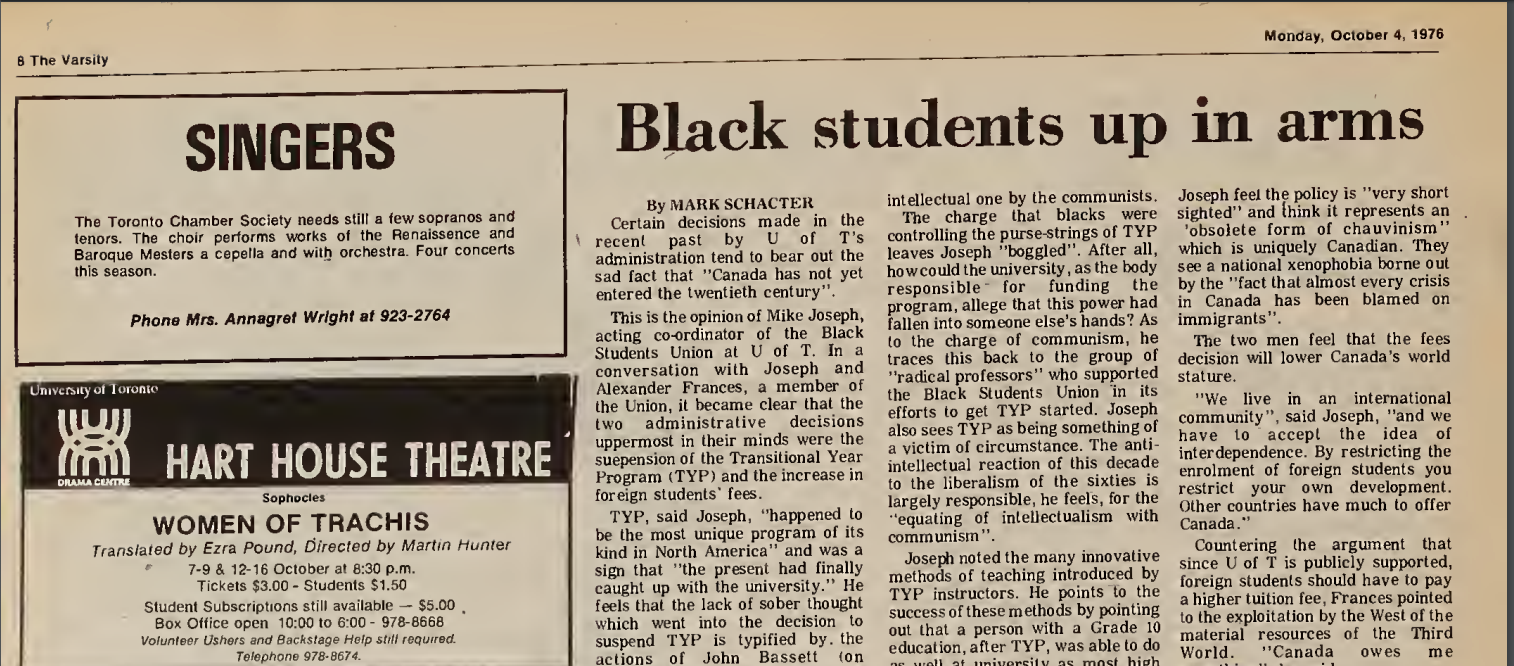
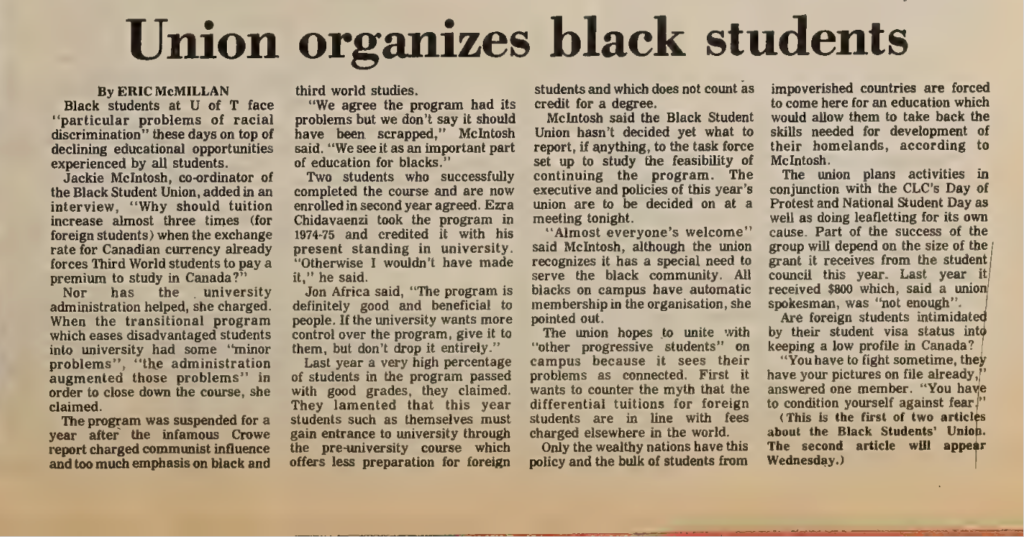
Reports and rumours leading to the suspension of the TYP program, however, did not go unanswered by members of the Black Students’ Union at U of T, and two crucial examples of their analyses were published in the fall 1976 semester. In an article published on September 27, then coordinator of the BSU, Jackie McIntosh, raises the TYP suspension in an interview with Varsity journalist Eric McMillan, arguing for the importance of the TYP and claiming that the administration used “minor problems” in the program as an excuse to close it down. McMillan also cites discussion with two successful graduates of the TYP, quoting one as stating that “if the university wants more control over the program, give it to them, but don’t drop it entirely.” At that time the Black Student Union had not yet determined whether they would submit a report to the task force assessing the future of the program. A subsequent article written by Mark Schacter and published on October 4th, cites interviews with Mike Joseph (identified as the BSU acting coordinator) and another member of the union named Alexander Frances. Joseph strongly asserts the need for the TYP and critiques the nefarious means by which it came to be suspended. Joseph and Frances refer to the program as successfully providing access to university for those who are not members of “the elite,” a significant shift in tone from the repeated descriptions of a program for “disadvantaged” youth. Joseph characterizes university administrators as having “sat around waiting for [the TYP] to fail” and, in the absence of such failure, as having “concocted” false allegations to discredit the program.
Joseph describes the TYP as “the most unique of its kind in North America,” suspended due to lack of commitment on the part of the university and allegations by U of T that “TYP had been ‘taken over’ by blacks and communists.” Joseph traces the TYP reputation for being under communist influence to “the group of ‘radical professors’ who supported the Black Students Union in its efforts to get TYP started.” Joseph predicted that the TYP would return, “in a bleached form” barely reminiscent of the program that had been created before the suspension.
THE TASK FORCE REPORT
The task force’s much awaited report was released in early January 1977 and analyzed in a January 24th article by Gene Allen titled “A wiff of racism remains.” The task force had determined the TYP to be a tokenistic but nevertheless “extremely significant” program addressing the educational needs of “disadvantaged students” in ways that were not otherwise being met in Toronto. It concluded that the need for TYP had indeed grown since its inception seven years prior, and thus the TYP was to be reinstated. As predicted by the BSU, the report also made clear that the TYP was to face major changes that would resituate it more firmly within the norms and control of the university. There was no longer to be a policy committee consisting of community members, teachers and students; rather, a program coordinator “of stature and reputation within the university” was to run the program without reporting to any such group of stakeholders. The report called for a shift in curriculum, away from that determined by the racial demographics of the population, while noting that TYP students required additional financial supports and the waiving of tuition fees.

Allen’s article highlights the tone of the task force’s final recommendation, describing it as a “stern warning”: “WE ARE CONVINCED that failure to implement our recommendations in their entirety or without adequate preparation in every respect should be a serious mistake that would impair TYP permanently”. Finally, Allen notes the failure of the task force report to address the egregious nature of the prior Crowe report and the damage it had caused as a “witch hunt for communists and black power advocates within the program, and particularly in the policy committee.” The failure of the task force to state a firm rejection of the Crowe report was a missed opportunity to counter and quell some of its “pernicious effects.”
The TYP would be reinstated in the 1977-1978 academic year, under the leadership of a psychology professor, Marty Wall, in the role of program coordinator with the maximum enrolment maintained at 50 students. Enrolment would fall, however, from 35 students at the start of the new year, to 25 students by March 1978. Despite the lower numbers, Wall would describe the program as “terrific” and the students’ morale as high, attributing the controversy that had led to the program’s closure the year before to there not having been “a clear line of authority.”
Sources
The Varsity:
Eric McMillan (September 27, 1976) “Union organizes black students,” p.7
Mark Schacter (October 4, 1976) “Black students up in arms,” p.8
(10 November 1976) “Students boost TYP”, p. 7
(January 19, 1977) “Transitional Year Program: Report wants it back again,” cover
Gene Allen (January 24, 1977) “A wiff of racism remains,” p. 5
(March 14, 1977) “Revived TYP gets a new boss,” cover
Andrew Rettig (March 29, 1978) “TYP program enrolment falls but student morale still good,” p.3
Suggested citation
rosalind hampton (2024). The TYP at U of T, part 2. Coalition Building on Campus. https://coalitionbuildingoncampus.ca/cboc-story/the-typ-at-u-of-t-part-2/