
The Student Non-violent Coordinating Committee
Part 2:
Winter, 1965
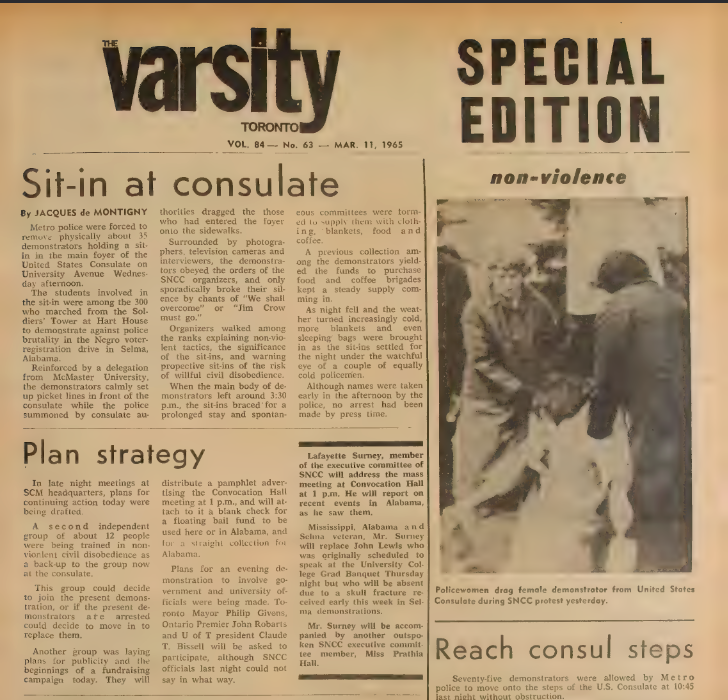
In the beginning of the winter 1965 semester, U of T Friends of SNCC received an urgent appeal from the SNCC Hattiesburg office in a letter shared with the Varsity and published in the January 11th, 1965, issue (p.9), that describes a financial crisis in the organization. The U of T students immediately began a fundraising drive, well publicized over the next several weeks, leading up to a concert by the SNCC Freedom Singers on January 22nd. On the day of the concert, a strongly worded reminder that it is the final day of the fundraising campaign is published on page 4 and signed by william n. coulthard (printed without capitalization), imploring U of T students to support SNCC’s work with a generous donation. The campaign was a resounding success and allowed U of T Friends of SNCC to send more than 3000 USD to the SNCC office in Atlanta (see letter to the editor, 03 Feb.1965, p. 5).
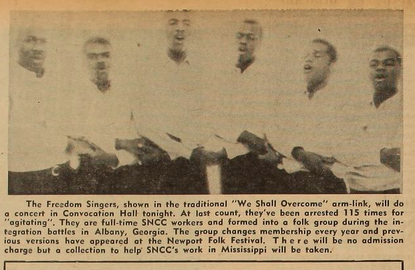
Meanwhile in Montreal, on 25 January 1965, the McGill Daily announces, “Campus to get SNCC; founding meeting today” (p.3) and provides an overview of SNCC’s aims and activities in the civil rights movement. Another announcement on page 5 calls on “all interested in forming a SNCC club” to meet at 1pm that afternoon. A few days later, on January 28th and 29th a concert by the Freedom Singers (being held on Jan. 30th) is announced as a fundraiser for SNCC without the organizing group identified. A song called “Freedom Singers here tomorrow” with lyrics attributed to Noel Roy, are published on page 5 of the issue, and include reference to McGill being a stop between U of T, and Université de Montréal (referred to as u of m) on the group’s tour:
From the u of t they came
on the way to the u of m
publicizin struggles slowly
gainin
at two pm they came
on the thirtieth of jan
to the auditorium of
leacock buildin
In an article appearing in the February 5th issue of the Daily, the concert is identified as having been sponsored by the newly formed McGill Friends of SNCC. The singers are described as SNCC field secretaries and polished performers who “sang freedom songs in an eerie, but very effective harmony” (p.8). The February 17th issue of the Daily announces a Friends of SNCC executive meeting to “discuss constitution” (17 Feb. 1965, p.7). Subsequently on March 5th, notice is published in the McGill Daily that SNCC is holding its “first membership meeting” that day. The article outlines SNCC’s main campaigns in the South and concludes by noting that the “McGill Friends of SNCC have stated that their aim is to eradicate racial prejudice and they will thus act as an official organ of investigation in Canada.”
On the same day, March 5th in Toronto, the Varsity announces that SNCC National Chairman John Lewis was scheduled to visit the U of T campus the week of March 12th, with talks scheduled at the University College graduation banquet, and at an open meeting sponsored by U of T Friends of SNCC. (Lewis was also scheduled to deliver the first guest lecture of McGill Friends of SNCC on March 16th [McGill Daily, 12 March 1965, p. 4]).
The brief Varsity article shares that U of T Friends of SNCC is preparing to send a telegram to U.S. President Johnson condemning police violence in Alabama and quotes a “SNCC official” as stating that “We as Canadians who are seriously concerned about the situation, have a responsibility to act on our concern. A renewed effort must be made to convince the American government that there is no place for racism in democracy” (05 March 1965, p. 3).
Friends Take Action
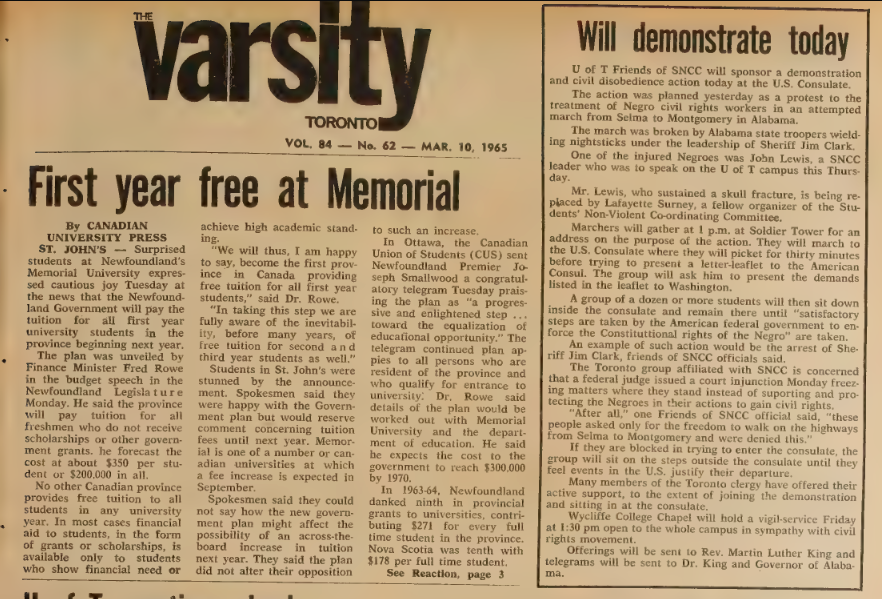
On March 10th the U of T Friends of SNCC announced a demonstration in a brief article on the front page of the Varsity. The article explains that the civil rights workers on the Selma march had been attacked by Alabama state troopers, and that John Lewis, who had also been scheduled to speak at U of T on the following day, had sustained a skull fracture, and would be replaced at the event by fellow SNCC organizer Lafayette Surney. The article invites protesters to meet at 1pm to march to the US Consulate, attempt to “present a letter-leaflet to the American Consul,” and “sit down inside the consulate and remain there until ‘satisfactory steps are taken by the American Federal government to enforce the Constitutional rights of the Negro’ are taken” (10 March 1965, cover).
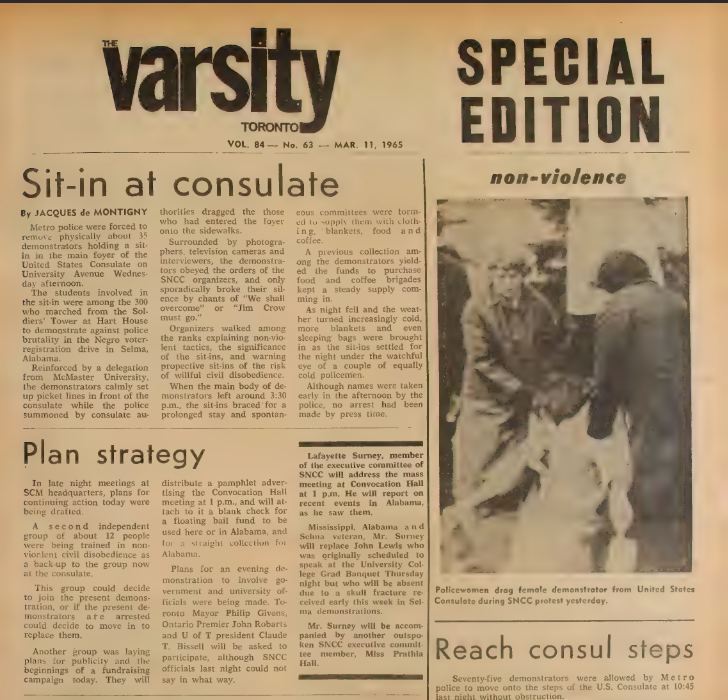
The following day, March 11th, a 4-page special edition of the Varsity is published to report on the ongoing protest at the US consulate. According to the lead article, 300 student protesters from U of T had participated in the march, with “about 35 demonstrators” holding a sit-in inside the foyer of the building for the afternoon before being physically removed by police. Joined by a contingent from McMaster University as well, the students held picket lines in front of the consulate. The article describes organized, disciplined civil disobedience led by the “SNCC organizers,” who circulated among those gathered explaining nonviolent tactics, and the significance and potential risks involved in sit-ins. Committees were organized and funds were raised from the site of the action to support a long-term sit-in outside of the consulate building. Another front-page article describes ongoing planning and training of protesters taking place at the Student Christian Movement (SCM) headquarters. Lafayette Surney and another SNCC representative, Prathia Hall, have come to campus as planned and will address a mass meeting on campus that afternoon. 75 student protesters have spent the overnight outdoors on the front steps of the consulate; “By midnight the composition of both demonstrating and support groups included people from every college and faculty, from McMaster, York and Western, African students and the odd anxious mother of a demonstrator come to see that her son or daughter was warm and comfortable” (p.4). On page 2, a statement explains that the special issue has been ordered because the U of T student protesters are making an important statement that everyone in North America should heed. It is the first special edition of the Varsity “since the Kennedy blockade of Cuba” intended as an urgent call to action for students to attend the meeting that afternoon, become aware and get involved. Apparently, they did.
The front-page of the March 12th issue of the Varsity reports that after the meeting, 320 students marched to the consulate and at least 15 attempted to enter while the remaining hundreds joined the picket lines. The police had by then forced the sit-in away from the consulate building to the sidewalk and become “less gentle about handling the students.” A group of high school students had joined the action, and “Casey Anderson, a Negro folks singer” was “coming down with Randy Ferris, a Toronto folks music disc jockey, to entertain [the protesters]” (p. 3). Prathia Hall and Lafayette Surney had delivered inspiring speeches at the March 11th meeting and joined the students in marching and singing freedom songs at the consulate. Hall told the students “The question of humanity is an international one, which crosses borders and should cross state lines, even into Alabama”, while Surney declared, “News of your demonstration is all over the South. In the South in America, we fear a lot because nobody cares about our problems. When I was downtown (at the consulate) I knew you cared” (12 March 1965, cover).
On Sunday, March 14th, thousands of protesters marched on the U.S. Embassy in Ottawa to protest police brutality in Alabama, including students from U of T, Queen’s, McGill, Carleton, Ottawa, and McMaster universities (Varsity, 19 March 1965, p.3).
In Montreal, on Tuesday March 16th a half-page article in the McGill Daily describes the escalating situation in Selma and violence being faced by the civil rights activists and refers to march in Ottawa the previous weekend. The article announces an urgent meeting called by the president of the Students’ Society who “urges all McGill students, ALL McGill students, as well as faculty and administration members” to gather that afternoon on lower campus to hear Lafayette Surney of SNCC’s National Executive speak. The articulated plan is for students to then march to the U.S. Consulate in Montreal to deliver “a message expressing their concern to President Johnson” (p.4) The Daily later recounts how on that day following the rally on lower campus, Students’ Society president Saeed Mirza led 1500 McGill students to the U.S. Consulate, and that the McGill Students’ Society “in conjunction with various campus organizations” had published an open letter to the U.S. president in a Montreal newspaper (Daily, 14 May 1965).
The March 19th issue of the Varsity announces that the sit-in at the consulate had ended on March 17, following a U.S. federal court order preventing the state from interfering with the Selma-montgomery march. The article also notes that on that same day (March 17), the student unions in Québec had notified SNCC headquarters of “their plans to march on the U.S. Consulate in Montreal and sit in front of it as long as the Toronto sit-in lasts” (cover). With the end of the Toronto sit-in that evening, the Montreal students would continue to picket until after the Alabama march was successfully completed.
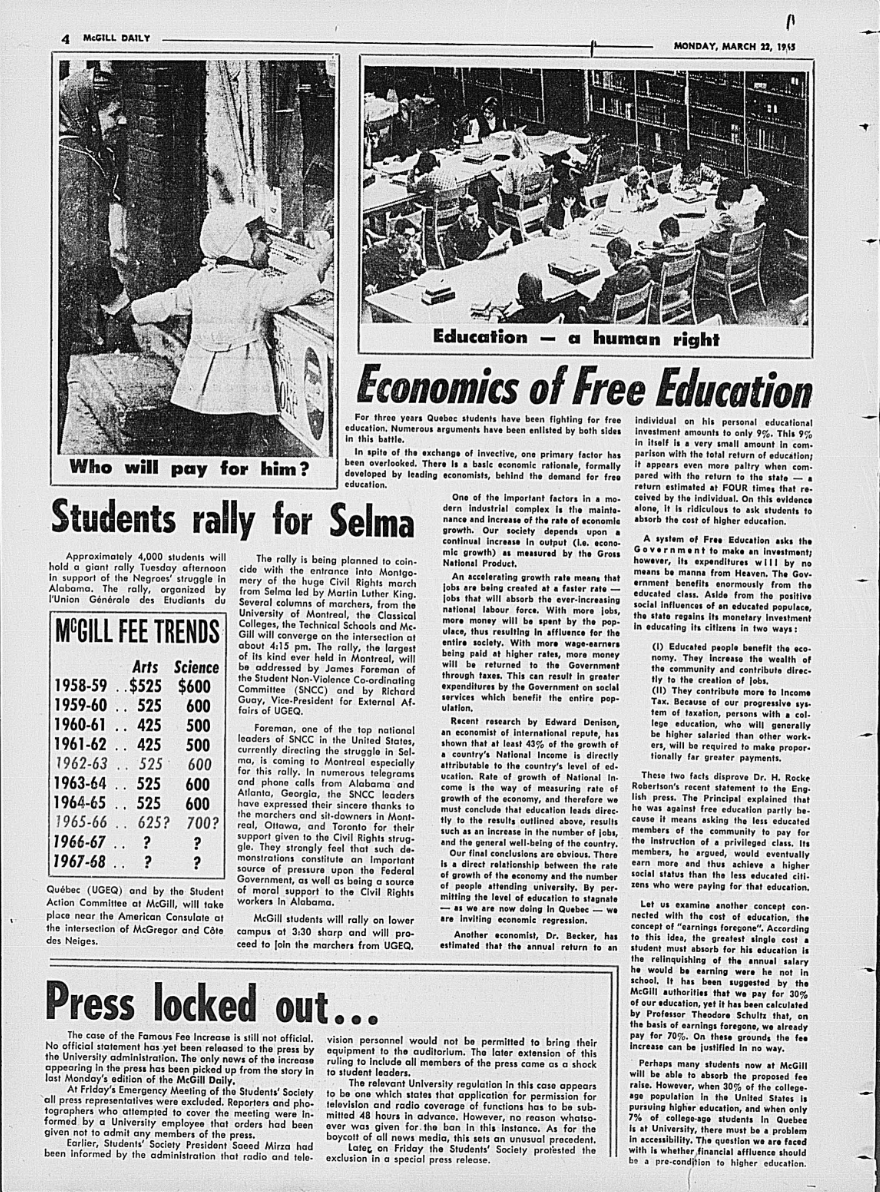
On March 22nd an article in the McGill Daily announces a major demonstration the following day, organized by l’Union Générale des Étudiants du Québec (UGEQ; the Quebec students’ union) and McGill’s Student Action Committee (SAC). The article appears amidst several regarding the ongoing, third year of battle by Québec students against tuition fee hikes, suggesting the competing demands on the student unions and activists during this time. McGill Friends of SNCC are not mentioned in the article, however the demonstration is a coordinated effort with SNCC to support the Selma march and is to be addressed by James Forman, a leading organizer with SNCC described as “coming to Montreal especially for this rally.” The article shares that “in numerous telegrams and phone calls from Alabama and Atlanta, Georgia, the SNCC leaders have expressed their sincere thanks to the marchers and sit-downers in Montreal, Ottawa and Toronto for their support given to the civil rights struggle” (p.4). A reflection on the event published at the end of the academic year describes Forman as having addressed the Montréal crowd in French (which he had studied at Middlebury College) and quotes a translated statement from Forman’s speech: “No man on earth is really free while others are fighting for their rights. We are not only fighting for the freedom of the American Negro. We are fighting for all those, black or white, who are suffering from discrimination” (Daily, 19 May 1965, p. 8).
Sources
The Varsity, 1965-. https://archive.org/details/varsity
The McGill Daily, 1965-. McGill University, Daily Publications Society, https://archive.org/
“James Forman,” Robert Penn Warren’s Who Speaks for the Negro? https://whospeaks.library.vanderbilt.edu/interviewee/james-forman
Suggested citation
rosalind hampton (2024). The Student Non-Violent Coordinating Committee. Part 2: Winter 1965. Coalition Building on Campus. https://coalitionbuildingoncampus.ca/cboc-story/the-student-non-violent-coordinating-committee-part-2-winter-1965/