

The Student Non-violent Coordinating Committee
Part 1:
U of T, 1963-64
The role of students, and particularly Black student organizers in the U.S. civil rights movement captured the attention of students in Canada. Reporting on the movement in the student newspapers includes articles republished from U.S. sources, as well as original reporting and commentary by journalists and other students on Canadian campuses.
On November 15, 1963, an announcement appears in the Varsity for a talk by Tom Wakayama, Canadian co-ordinator for the Student Non-violent Coordinating Committee, speaking on “the SNCC School of Non-Violence and the use of non-violent direct action in the U.S. civil rights movement” (p.3). The November 29th issue describes Wakayama as having proposed that students organize “a Toronto chapter of the SNCC,” following what had been the recent “formation of the first Canadian chapter at the University of Western Ontario.” The brief article describes SNCC representatives already appointed at Victoria College and New College and notes plans for a Toronto “city-wide organization of the Friends of SNCC, as well as chapters at York University and Ryerson Institute” (p.2).
Following the meeting among student representatives and Wakayama, a meeting about organizing the “Toronto Non-violence Committee” is announced in the Varsity on December 9th (p.3). The article states that while Wakayama’s focus had been setting up a U of T Friends of SNCC to fundraise for the U.S. civil rights movement, “Toronto students felt there was a definite need for local action by students in the cause of social order,” specifically citing police violence in the Regent Park area. The students and Wakayama agreed that the local contexts would be given priority, while the Toronto committee would also provide financial assistance to the U.S. movement. A cover story in the December 11th issue of the paper features a photograph of Wakayama and the president of the Students’ Administrative Council, Doug Ward. Wakayama, identified as a student at Western University, continues to make the case for U of T students providing financial and moral support for the U.S. movement. An announcement and article appearing in the January 24th, 1964, issue of the Varsity however, suggest that fundraising on campus for SNCC is not as lucrative as the students involved had hoped it would be (they had raised $223.00), and that the question has been raised as to whether campus-wide fundraising campaigns were legal (24 Jan. 1964, p. 2, 4).
Wakayama appears again in the pages of the Varsity on 03 Feb. 1964 (pp. 4-5), this time as an author. Having graduated from Western and now a field worker for SNCC, Wakayama reports on the conditions faced by Black residents and SNCC organizers in the “police state” of Alabama. He describes having arrived in Birmingham just 7 hours after the bombing of a Black church that killed four Black children. Wakayama depicts the “violence and terror that dominates the South” in significant detail, describing the sadistic horror being inflicted on Black people by police and state troopers authorized by the government. The article concludes with an assertion that despite the violent conditions they face, SNCC will continue their work; “The Negro of the South is on the march and he will not be turned back” (p.5). (The SNCC Digital Gateway states that as a young child, Tamio [“Tom”] Wakayama was sent with his parents to a World War II internment camp for Japanese-Canadians for the duration of the war, an experience that made him particularly attentive to state oppression and eager to join SNCC and the civil rights movement.)
On February 7th, a cover story in the Varsity reports that a local committee to support students in Bloomington, Indiana had decided to seek coalition with other civil rights groups on campus, including SNCC. Three Bloomington students, all white men and members of the Young Socialists Alliance, were facing criminal charges for advocating for the use of violence by Black Southerners in their struggle for civil rights. The article suggests a dismissive attitude toward the interracial civil rights groups in contrasting “a myriad of initials meaningless to most: CORE, SNCC, etc” with descriptions of overwhelming support for the Bloomington students since one of the three, Tom Morgan, had visited the U of T campus to promote awareness of their case the previous week. According to the article, the Bloomington Committee organizers felt that the interest in the Bloomington students’ case could be used to garner support for other civil rights cases.
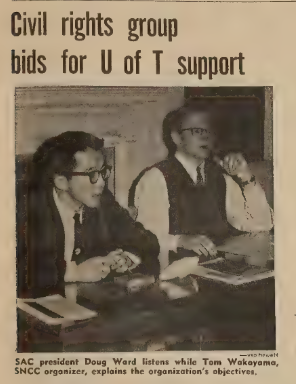
Varsity, December 11 1963
SNCC Tries Again: Fall 1964
On page 18 of the October 2, 1964 issue of the Varsity, an article by Volkmar Richter under the headline “SNCC Will try again at U of T” announces a second attempt to establish a Friends of SNCC organization. The article describes the renewed effort as being run with more organization and leaders “who know what to do, who to contact and how to go about it.” One leader of the initiative, Diane Burroughs had spent the summer working in SNCC Freedom Schools in the U.S. South and is described as believing that students at U of T are “interested in the Negro’s problems, know of his plight and want to help” [Burrows’ last name is misspelled here and elsewhere in the Varsity; SNCC files confirm the correct spelling as Burrows]. The author notes however, the presence of opposition to Friends of SNCC on campus by those who argued that “such actions are political in nature and that U of T should not become mixed up in American politics.” Another of the renewed group’s leaders, Heather Dean, counters that “this is a social and human problem, not a national and political [one]…The U.S students have just taken the lead in this and we’re helping.”
On October 9th announcements appear for the first open meeting of Friends of SNCC to be held the following week, at which Burrows and Bob Johnson, described as “two Canadian civil rights workers” would discuss their experiences working with SNCC in Mississippi (pp. 21-22). Another article by Richter appears in the October 14th issue (p.3), reporting back on the meeting. Burrows had shared experiences of facing verbal aggression and threats from white southerners and had informed those in attendance that in September alone there had been 11 bombings in the area where she had worked in the Freedom Schools. Johnson had taken “a tour of the south to see the conditions there” and was surprised to find how dire they were despite the passing of the civil rights bill. The article also notes the election of a Friends of SNCC chairman and describes plans for further activities raising awareness and funds for the movement. The cover of the November 4th issue and several announcements in the days that follow promote an upcoming appearance by US folk singer and SNCC organizer, Len Chandler, to open a Friends of SNCC series of lectures and seminars. The November 4th notice also gives the address of an organizational office the group was setting up, and welcomes “anyone interested in helping to drop by.”
The Friends of SNCC at U of T continue to organize meetings and rest of the fall 1964 semester; gatherings are announced in the Varsity, where students would listen to tapes produced by SNCC or about the movement in the South. These include a two-part tape produced by CBC, titled Project ’65—Mississippi,” played on November 18th and 19th, and another on December 3rd of John Howard Griffin (author of Black Like Me; a white man who had disguised himself as a Black man to travel the South and better understand and verify Black people’s claims about antiblackness).
Sources
The Varsity, 1963-1964. https://archive.org/details/varsity
SNCC Digital Gateway (n.d.). Tamio Wakayama. https://snccdigital.org/people/tamio-wakayama/
Suggested citation
rosalind hampton (2024). The Student Non-Violent Coordinating Committee. Part 1: U of T, 1963-64. Coalition Building on Campus. https://coalitionbuildingoncampus.ca/cboc-story/the-student-non-violent-coordinating-committee-part-1-uoft-1963-64/