

Theme: The Struggle for Black Studies
Students at universities in Canada have been organizing and mobilizing to demand that their universities offer Black Studies courses and programs since at least the 1960s. This work has most often been led by Black students working in coalition across departments, faculties, and universities. It has also involved members of local Black communities; Black scholars across institutions (nationally and internationally) and a multiracial range of activist students and faculty. Despite these efforts, with very few exceptions Canadian universities refused Black Studies until well into the 2010s, and it remains to be seen whether more recently stated commitments to develop programs, departments and institutes of Black Studies at Canadian universities will be realized. As has been the case in the United States, the development and sustenance of critical Black Studies in Canadian academia, is indebted to the ongoing work of coalitions led and sustained by Black students.
A link
McGill University, 1968-1970:
Black Power and Black Studies
Stories of Black students at McGill organizing for Black Studies have been passed down from one generation of students to the next in campus groups and study circles, through conferences and symposiums. They are stories that live beyond the institutional borders of McGill, within local Black families and communities of Montreal. We find the story offered here in the pages of the student-run McGill Daily: in announcements of meetings and events, in letters to the editors, and in articles documenting students’ organizing efforts, political analyses, and the administration’s responses to their activism. It is a story of cross-campus organizing between students in Montreal, in relation with Black community activists in Montreal and Halifax, and the Black Power movement in the Unites States, of which programs and departments of Black Studies were a central demand.
PART 1 – BLACK POWER
By September 1968, a bold headline reads that “Black Power is coming” to McGill, announcing Stokley Carmichael’s return to McGill as part of a Congress of Black Writers (described as a “Black Power conference”) the following month. It was organized by a coalition of Black students and community members, and bringing an international group of writers, artists, and activists to the campus, including Rocky Jones from Halifax. The Congress of Black Writers at McGill marks a critical event from which the momentum of Black student-led organizing in Montréal continues to build.
In the Nov 13th and 14th issues of the Daily, a small announcement reads: “Black Power for Canada? See and discuss “Encounter at Kwacha House—Halifax,” advertising a screening of the film on November 17th. The 17-minute-long film documents a multiracial community conversation among educators, organizers and youth in Halifax; it offers a candid discussion about fighting racism, education, similarities and differences between Canadian and U.S. contexts, the potentials of economic boycotts, and the role of violence in struggles for justice (Tasker, 1967). At the end of the month, the Daily reports on a Political Science Association strike involving a student sit-in on the fourth floor of a building on McGill’s downtown campus. Co-organizer of the Congress, Rosie Douglas, is identified as a speaker at the sit-in, giving a talk on “Black Power in Canada as it relates to the U.S.” (“Schedule”, 26 Nov. 1968, p. 2). On November 27th, an announcement appears under the heading BLACK STUDIES, calling “all black students” who are interested in working for a national and international black community organization to attend a meeting that evening, noting “There will be a discussion of the black studies program in which some interest has been evinced at McGill University” (p.4). For the rest of the fall 1968 semester the Daily continues to publish articles about the Black Power movement in the U.S., with particular attention to the student strike and demands for Black Studies at San Francisco State College.
In January 1969, attention shifts to the Black student-led resistance to racism at Sir George Williams University (SGWU), which had been ongoing since the previous April and would end in the takeover of the university’s computer centre on January 29th. The evening prior to the takeover of the computer centre, more than 100 Black students and community members had met at McGill to listen to speakers from the SGWU Black Students’ Association. Another McGill student who had been involved in organizing the Congress, Keith Byrne, is quoted in the Daily as having argued that “the very foundation of this country is racist” exemplifying how the students were clear that what was happening at SGWU was part of a much larger set of interlocking power relations. “The corporate university cannot tolerate Black Power, student power, or democratization,” Byrne continued, “those of you who fight for change in the university must help us, because you can’t win if we don’t. The university is part of the corporate elite, and one of its essential functions is to resist change” (“McGill blacks rally” Jan 29 69, cover).
Journalists at the Daily and the Georgian at SGWU obtained and published the confidential minutes of a meeting between the SGWU administration and the police revealing militarized planning by the university and police, in response to anticipated violence by Black students at the hearing regarding the charges of racism. The published document outlines a plan for a “command post” in an office on campus, several plains-clothed police officers on site, and the recruitment of university staff to assist with surveillance and possibly arrests. Notes document the suggestion to “make a list of students who are ex-policemen, etc. who might be helpful in such circumstances” in the future (29 Jan 1969, “Reasoning Together,” p.5). Despite all the planning, a coalition of students would stage a walk out of the hearing and successfully take over the SGWU computer centre.
Two days into the takeover of the computer centre, the McGill Student Council voted to both “condemn the ‘gross mishandling’” of the hearing at SGWU, and to grant $660 to the McGill Debating Union for the funding of an informal Black Studies program (cover, Jan 31 69). The Daily had earlier reported on how funding for speakers’ fees “in conjunction with the Black Studies Program at Sir George Williams University” had prompted great debate in Student Council about whether such financing was the responsibility of the Students’ Society or the University administration (22 Jan. 1969, cover). The situation at SGWU having escalated, the need for the students to move forward with the funding seems to have been clarified. The Black Studies program would be launched immediately, as a weekly lecture series featuring prominent Black male thinkers from the U.S. and announced weekly in the pages of the Daily: on January 24th, James Turner (a PhD student who the previous year had led a sit-in at Northwestern University of which a successful demand had been the development of Black Studies curriculum); Chichi Onwauchi (Director of the African-Caribbean Study Centre at Fisk University) on January 30th; Charles Hamilton (professor at Roosevelt University and co-author with Carmichael of “Black Power”) on February 6th; Julius Lester of SNCC on February 12th, Michael Thelwell of SNCC on February 20th; and on February 27th, Robert S. Browne (Black Power and antiwar activist, and professor at Fairleigh Dickson University).
The announcements identify the informal program as a collaboration between the McGill Debating Union and the Black Students Association at SGWU. Following the takeover of the computer centre and its extensive aftermath, several references to a “proposed Black Studies Program at SGWU” appear in the Daily, particularly in articles in November and December 1969 regarding a racist cartoon published in a SGWU student publication called The Paper, depicting two black people preparing to enroll in the program. One description of the cartoon describes “two blacks, one with a machine gun, the other with a newspaper, against a background of Biafran and black slogans” with a caption reading, “Pick up your bags Alfred, there’s a black studies program starting at Sir George” (Baker, 05 Nov. 1969, cover). Another describes it as depicting “two blacks as cannibals preparing to go to Sir George for the proposed Black Studies program” (Schusheim, 12 Dec 1969, p.21).
PART 2 – 1970: THE DEMAND FOR BLACK STUDIES
As the first anniversary of the computer centre take-over arrives and passes, the court hearings related to the events are ongoing and continue to be reported in the Daily. Throughout the winter 1970 semester, the newspaper also records Black students’ continued organizing and sustained pressure on the McGill administration to set up a Black Studies program at their university.
On January 23rd, a full-page article (p.4) by PhD student Dennis Forsythe makes the case for “Black Studies and its significance at McGill,” identifying Black Studies as grounded in the understanding that “racism and discrimination are products of a particular type of social organization and a particular type of individual—the ignorant individual.” Forsythe is also clear that: “Black Studies rejects the stereotyping of blacks; it also rejects the stereotyping of whites as inherently ‘devils.’ It offers the last chance for an educational solution to the racial problem.” Wittily referring back to the cartoon of the previous semester, Forsythe writes,
Let me reassure those whites who are scared, and who may be tempted to cry: “Pack your bag Alfred. They are about to start a Black Studies Programme (at McGill),” that the function of Black Studies is not to replace one particularism with another but to counter-balance the historical effects and exaggeration of White particularism towards a more balanced society.
On January 26th, a tiny announcement appears in the Daily inviting “anyone interested in forming a Black Studies program” to meeting that afternoon. The following day an article is published titled “Black studies at McGill?” noting that 30 people had gathered for the meeting the previous day and identifying the initiative as organized by three graduate students—Dennis Forsythe, Carl Parris, and Roosevelt Williams. The organizers had begun discussions with members of the university administration and would be presenting the need for a Black Studies at the Senate Academic Policy Committee meeting later that week. The article also states that decisions regarding the program (implicitly among Black students themselves) would be made following a meeting being organized with prominent Black scholars to be held on the day after the Senate committee meeting.
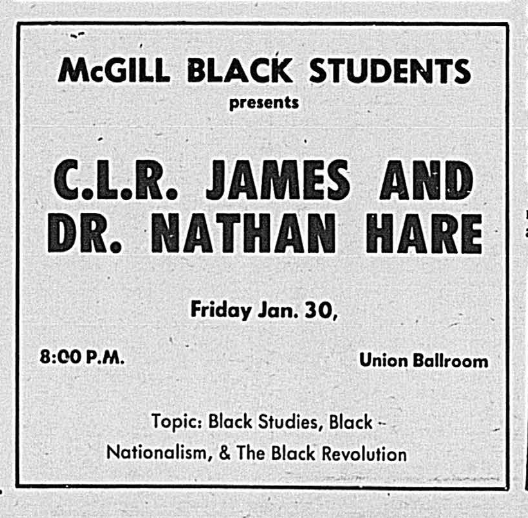
On January 30th, the Daily publishes several announcements of this second meeting of the students, featuring a discussion with renowned professors of Black Studies, CLR James and Nathan Hare who would speak on “Black Studies, Black Nationalism and The Black Revolution” (p. 2, 4). On February 2nd, the Daily reports on the event in an article by Krishna Nirmel, noting that the evening opened with comments by Carl Parris asserting that the events the previous year at SGWU, and their ongoing aftermath in the courts had “opened the eyes of all black people to Canadian society. Black Studies will partly be an answer to racism in Canada, he claimed”. CLR James is described as having argued that Black Studies is part of—not a replacement for—Black struggle; that it “is not a concession to black students, but a contribution to the intellectual life,” and that it is “not ancient history. It is a study of the society” (Nirmel, 30 Jan. 1970, p.5).
The meeting of the Senate Academic Policy Committee resulted in the formation of a subcommittee composed of five faculty and five students to study the students’ proposal for Black Studies at McGill. A cover article published on February 16th states that the Dean of Arts and Sciences would chair the subcommittee, and names four of the five faculty representatives, while Forsythe, Parris and Williams would appoint the student members of the subcommittee.
Acting as spokesperson for the student organizers, Parris emphasized that courses in a Black Studies program should emphasize Black history and Black scholarship, be open to all students and should be taught by Black professors. The article concludes with reference to the establishment of black studies programs at many U.S. universities “often following hard-fought campaigns by student organizations” and calling attention to existing “special” programs at McGill including French Canadian studies, Jewish studies, and Islamic studies (Beiler, 16 Feb. 1970, p.2.).
Another article by Forsythe appears on page 4 of the February 18th issue of the Daily, describing a movement to institute Black Studies at McGill. Forsythe argues that Black Studies at McGill as much needed “to counteract WASP Studies” and the current “convenient ignorance” of Black people’s histories and struggles. Explaining the formation of the subcommittee and its role, Forsythe announces “Black Studies Nights” every second Wednesday beginning that week: “an experiment in dialogue, when both whites and blacks can discuss certain basic issues,” following a presentation by a guest lecturer. The meetings are thus presented as an educational initiative and opportunity for students to develop and discuss their ideas about Black Studies in Canada in general, and at McGill in particular. Forsythe asserts that “a Black Studies program, and the drive to institute it, is of interest not only to the Blacks but also to the general student movement, the Women’s movement, Faculty movements, Nationalistic movements and working-class movements.”
A March 4th article announces that the details of the Black Studies program are being “hammered out” by the subcommittee, and that the program will “hopefully be instituted this September” (p. 3). It states that a “major problem” has arisen: the subcommittee has also been asked to consider courses for “other Canadian minority groups, specifically, the Indians, Métis and Eskimos.” Parris is cited as arguing that the deliberations are going too slowly, while the Dean chairing the committee claims that extensive discussion is “necessary to ensure the creation of a high-quality program.” The Dean’s position is clarified in an article by Nathalie Apouchtine the following day, in which he is quoted as stating that “setting up the committee does not mean we give the program priority,” that the proposal from the students was “not complete enough to consider” and therefore the program “is not justified at the moment” (5 March 1970, p.3).
The Daily next reports that the Black Studies Association’s first meeting of the new academic year on September 22nd (cover). An article published on September 23rd shares that Sally Cools chaired the meeting without mincing words, describing Black students as “being fucked around left, right and center at McGill” and “tired of just listening to speakers.” Carl Parris is also quoted in the article as having argued that McGill’s support for the new Across the Halls “remedial program” intended to support the admission of more Black Canadian students to McGill, was an attempt by the senior administration to “pacify” the previous year’s Black Studies group “without installing a Black studies program.” The article identifies the group as the Black Students [rather than Studies] Association and lists their plans as including coordinating with Black student groups across Canada, expanding Black Studies program and involving Black students in campus media (Beck, 23 Sept. 1970, cover). References to Black Studies at McGill in the Daily subside at this point. Announcements of the Black Students Association activities continue to intermittently feature in the paper, as students build the foundations of what would become the Black Student Network and pick up the struggle for Black Studies in years to come.
Sources
McGill Daily Archives (1965-1970), McGill University, Daily Publications Society, https://archive.org/
Tasker, R. (1967). Encounter at Kwacha House—Halifax [film]. National Film Board, https://www.nfb.ca/film/encounter_at_kwacha_house_halifax/
Further Reading
Austin, D. (2023). Fear of a Black nation: Race, sex and security in sixties Montreal, 2nd edition. Between the Lines.
Austin, D. (Ed.) (2018). Moving against the system: The 1968 Congress of Black Writers and the making of global consciousness. Between the Lines.
Cummings, R. & Mohabir, N. (Eds) (2021). The fire that time: Transnational Black radicalism and the Sir George Williams occupation. Black Rose Books.
hampton, r. (2020). Black racialization and resistance at an elite university. University of Toronto Press
Suggested citation
rosalind hampton (2024) McGill University, 1968-1970: Black Power and Black Studies. Coalition Building on Campus. https://coalitionbuildingoncampus.ca/cboc-story/mcgill-university-1968-1970-black-power-and-black-studies/