

Theme: Visiting Scholars for Black Study
A key strategy of self-directed study among Black students has been to reach out to Black scholars and activists beyond their universities, and to arrange opportunities to learn with and from them. Such initiatives have ranged from short term engagements with visiting scholars; to informal classes and relationships sustained over years, as between Black radical thinker and historian CLR James and members of the Caribbean Conference Committee and CLR James Study Circle in the late 1960s in Montreal.1 Particularly in the absence of formal programs of Black Studies and the drastic underrepresentation of Black faculty in Canada, Black students initiated and formed relationships with mentors whose work mattered to them and could support them in their scholarship and activism.
chapters
On March 30, 1995, Black Caribbean poet and writer M. NourbeSe Philip gave a lecture at McGill University.
One week after Philip’s lecture, “Making Memory Matter,” an article with the same title was published in the Daily (Thursday April 5, 1995, p.11). This article was penned by then undergraduate student Pat Harewood, who was involved in both the Black Students Network and the Shakhti womanist collective, and who played an active role in the 1990s Black student organizing for Black and African studies on campus. This is also a period when many Black visiting scholars were invited to campus, by a variety of groups speaking on a wide range of themes and issues.
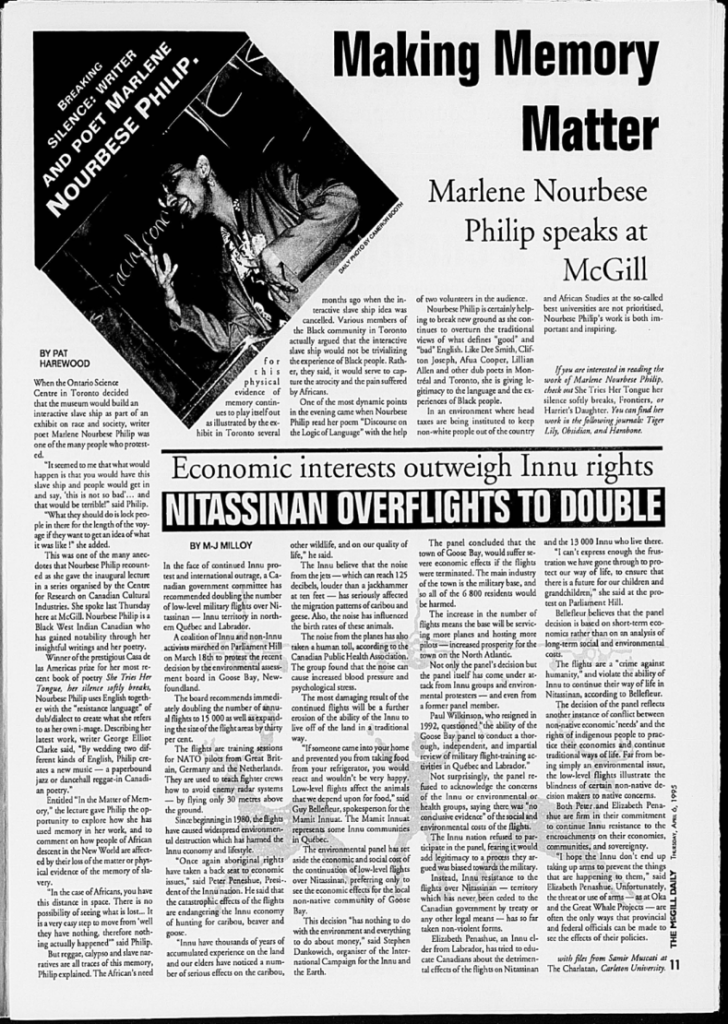
The Daily article is presented in a way that gives insight into some of the dynamics at McGill in the 1990s around students’ self-organizing and building networks to learn more about Black politics, history, and culture. Attending, engaging with, and reporting on a talk like “Making Memory Matter” by Philip is one example of this.
The article is framed with a photograph of Philip included in a black box, and the words, “Breaking the Silence: Writer and Poet Marlene Nourbese Philip” in white, included in a small black triangle placed atop the box. This appears on the left side of the page at a forty-five-degree angle. Across from this on the right side, the title of the lecture is included with the speaker’s name a second time included as a subtitle: “Marlene Nourbese Philip speaks at McGill.” The way these titles, subtitles, and picture are presented lend the lecture an importance and give the article a substantial amount of space on the newspaper page. They also suggest the importance of a talk like this that broke the institutional silence about Black life and resistance.
These ideas come through further within the article’s narration. The story of the lecture opens with an anecdote about how Philip had joined others to protest the Ontario Science Centre in Toronto’s exhibition on race and society that included an “interactive slave ship.” The article moves back and forth between discussing the Toronto Black community’s reactions to this exhibition—that was eventually cancelled—and Philip’s poetry that breaks new ground in giving, “legitimacy to the language and experiences of Black people.”
The article reports that Philip’s lecture was the “inaugural lecture” in a series sponsored by the Centre for Research on Canadian Cultural Industries and Institutions, a centre that existed at the university throughout the 1990s. Though there are no further articles about this lecture series in the Daily in 1995, activities of the centre are reported on throughout this period in the paper. The director, Will Straw, speaks about reconfiguring what “Canadian Culture” is, for example. In 1995 and 1996 the Daily reports on activities sponsored by the centre including a lecture called “Can Hockey Be Saved as Canada’s National Sport?” and another called “The Jewish Mark in English Painting.”
Though Philip’s lecture was not organized by students, it clearly can be linked to the types of radical self-education Black students were working toward and organizing themselves to do in this era. This article demonstrates how Black students used lectures like this one, and those by other visiting professors over time, to build their knowledge and critical awareness. The link is made explicit by the author in the ending lines of the article itself: “In an environment where head taxes are being instituted to keep non-white people out of the country and African Studies at the so-called best universities are not prioritised, Nourbese Philip’s work is both important and inspiring.” Showing the commitment to further promoting and educating about Philip’s work, the article is complete with a list of books for further reading– She Tries her Tongue her silence softly breaks, Frontiers, and Harriet’s Daughters.
Notes
1. On the CCC and CLR James Study Circle, see David Austin’s (2009) Education and liberation, McGill Journal of Education 44(1), 107-117; and (2013) Fear of a Black Nation. Between the Lines.
2. Marina Cupido (19 Jan 2015). Experiencing blackness in Canada: Professor highlights inadequacy of ‘multicultural’ narrative in McGill Talk. McGill Daily 104(15),
Additional Resources:
M. NourbeSe Philip’s website: https://www.nourbese.com/
On the project of bringing Black speakers to campus in 1990s: https://www.thetribune.ca/we-who-ran-the-mcgill-daily/
Suggested citation
Michelle Hartman (2024). M. NourbeSe Philip at McGill (1995). Coalition Building on Campus. https://coalitionbuildingoncampus.ca/cboc-story/m-nourbese-philip-at-mcgill-1995/