
1973: palestine and the mcgill Student Movement
Part 2
Since 1969, the McGill Student Movement had become increasingly known on campus as radical communist organizers, hostile to the university senior administration and willing to engage in direct action tactics. The MSM was staunchly against U.S. Imperialism and had worked in coalition with other groups such as the Afro-Asian Youth movement, Italian Student Movement and Théâtre Radical Québecois (Sept. 30, 1970) and in the fall of 1971 had held a forum on the potential for building a resistance movement in Québec (Nov. 18, 1971). MSM members had been beaten and arrested on campus by Montréal police in September 1972, after refusing orders (from campus security, then from the police) to stop distributing/ selling Communist literature on campus—an incident that resulted in three MSM members charged with “assaulting a police officer in the performance of his duty” (Sept. 19, 1972, p.6). The following months, members of the MSM disrupted a lecture by former US Department advisor Zbigniew Brzezinski, an action for which two received thirty-day suspensions (Oct. 18, 1972 p.4).
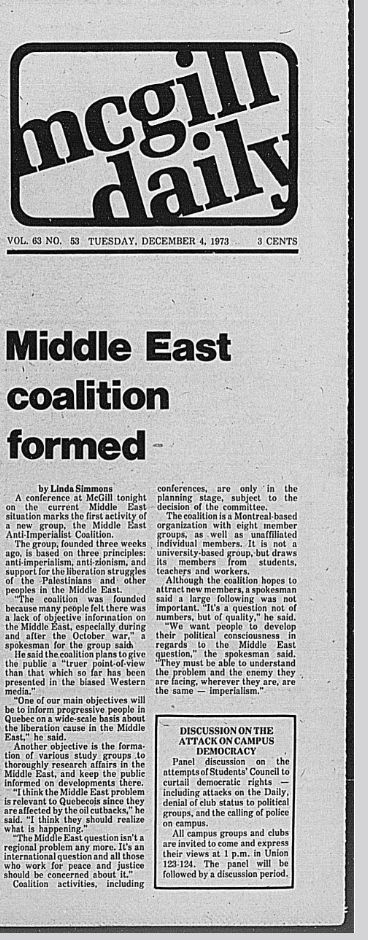
Articles, notices, and letters published in the Daily over the course of the fall 1973 semester record the ongoing attention to the situation in Palestine, and an increase in the anti-Zionist organizing on campus by the MSM.
On September 27 and 28, 1973 notices appear in the paper, inviting all students to attend a conference being sponsored by the Quebec-Palestine Association and held at Sir George Williams, on “the Palestine problem.” Norton Mezvinsky (misprinted Morton Mezvensky) was returning to Montreal as one of the speakers to give a talk on “Zionism as the cause of the Arab-Israeli conflict,” along with Barry Rubin, foreign editor of The Guardian who would speak on “the role of the US in the conflict.”
A small cover story published on October 10th reports that a crowd of 300 “members and supporters of the Arab community in Montreal” had gathered at McGill’s Roddick Gates for a demonstration along Sherbrooke Street downtown to protest “Israeli aggression,” just days after the onset of what later became known as the October War. The following day, a two-page spread in the Daily features interviews by Daily editor Joan Mandell, with both the Palestinian-born President of the Quebec-Palestine Solidarity Committee Rezeq Faraj and Myer Bick, the National Director of the Canada-Israel Committee, who had “led a group of Canadian volunteers to Israel to help out during the ’67 war” (p.4). The article is preceded by the claim that “the current war in the Middle East has aroused strong controversy at McGill as it has throughout the world.”
The November 15th issue of the Daily begins to document an escalation in tensions on campus, in a letter signed by a student named Benji Steinfeld. Steinfeld describes an intense debate at the student union that had occurred the previous day, regarding “a headline and subsequent article in the Marxist Leninist Daily denouncing Zionism in no uncertain terms” (p.6). The writer states what when he asked to see the paper, he was called a “Zionist, Racist, Fascist” and his request was refused (p. 6). The letter goes on to describe “the Marxists” as insisting that “Zionism is synonymous with Racism, Fascism, Nazism and aggression” and declaring that “the Jewish people have always opposed Zionism” (p.5). Steinfeld counters that he is “one Jew who, with at least 50 counterparts, supports Zionism” (p.5). The heated argument, according to the letter, ended when the students were threatened with police intervention.
On November 22nd, tensions between students escalated into a physical confrontation. The lead article on the cover of the Daily on the following day announces: “Four arrested in clash at Union.” The article details a fight that broke out at an MSM event, leading to the arrest of MSM members Ze’ev Ionis, John Robertson, Larry Tansey, and Robert Wallace. The MSM, described as “a student unit” of the Communist Party of Québec, had held their third “mass democracy” to “denounce Zionism” and “Zionist aggression against the Arab peoples” at the student union building. The meeting was disrupted by 3 students singing in Hebrew. Members of the MSM subsequently got into a physical confrontation with the disruptors and were ejected from the student union building. The police were called by the building manager and the 4 members of MSM were arrested and charged with assault and disturbing the peace. They were banned from the student union building by the executive of the student council.
An Editorial also appears in the November 23rd issue of the Daily, characterizing the “violent confrontation” at the student union as a “frightening example of how not to carry on political debates and win people over to a cause” (p.4). The editors acknowledge that “in past years” the paper had “taken anti-Zionist positions in editorials and commentaries” and stresses the necessity of “reasoned and factual” political arguments such as those that the paper had been supporting. They lament that in the past three weeks of holding what they called “mass democracies” on the issue, the MSM had “resorted to sloganeering” in place of “detailed political explanations,” which had alienated students who may otherwise had been willing to learn new views on the Middle East and “pushed them to the right and brought the worst forms of racism and chauvinism into prominence.” The editors go on to caution that the police intervention had set “a very dangerous precedent,” particularly “the speed with which several marked and unmarked patrol cars surrounded the Union” and “the presence of undercover cops in the Union before the incident.” They conclude by asserting that provocation and intimidation between Zionists and anti-Zionists would “impede the serious political debate that is so necessary on the Middle East and many other issues.”
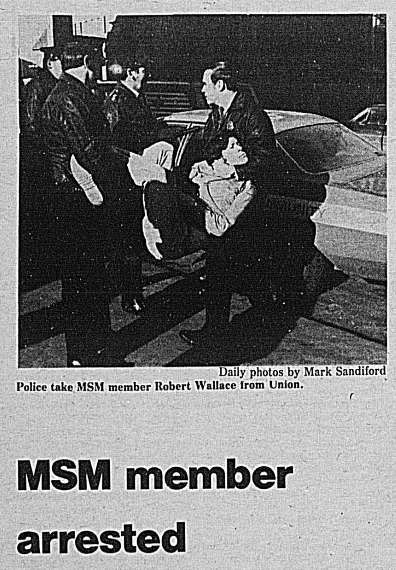
Members of MSM, however, continued to be involved in heated confrontations, characterizing both the police and students’ council leaders as “Zionist collaborators” (Nov. 23, cover). MSM maintained pressure on the students’ council regarding the banning of MSM members from the union and what they deemed fascist and unfair regulations regarding the use of the building. An article published on November 27th reports that Robert Wallace had tested his ban from the building, police were called again, and he was carried out of the building struggling and charged with assault.
On November 28th, a full-page article by Stephen Aronson seeks to make “the radical case for Zionism,” a response to a full-page review by Don Tapscott and Al Cappe, of The Other Israel: The Radical Case Against Zionism edited by Arie Bober that had been published the previous week. Addressing himself to the authors of the review article, Aronson seeks to debunk anti-Zionist arguments to reveal “maximalist positions of each people” as the “irreducible root problem of the conflict” (p.4). Aronson describes his position as “anti-maximalist Zionist,” a position that accepts that “the whole land of Palestine is big enough for both peoples.” He worries that he has seen no evidence “that the Palestinian position is anything but a maximalist one,” and reminds readers that “a democratic secular state already exists in part of Palestine: this is Israel.” He goes on to argue that the inherent nature of the nation state is exclusivist: “If we are to oppose borders between people, then let us be consistent in our anarchism. Otherwise, you see, I’ll feel you’re picking on me” (p.4). Finally, Aronson claims to have been most “hurt” by the claim that British imperialism supported Zionism, insisting that the British in fact had tried to destroy Zionism since 1922. He concludes his response with the wish to “see some way out of here, but I’m not sure that there’s anyone left here to talk to other than jokers and thieves” (p.5).
Between November 23 and 30th police intervened on campus and made arrests on three separate occasions. A cover article published on November 30th, Nigel Gibson reports that on the previous day, Ze’ev Ionis had been arrested again, as he addressed an MSM mass democracy meeting on Zionism in the union building from which he was still banned. Gibson reports that Wallace, and John Robertson were “still in jail,” while Tansey had been released. Approximately 100 students attended the November 29th meeting, which Ionis explained had been called to “express support for the just cause of the Palestinians and other Arab people.” Gibson notes that members of the Montreal police force’s “anti-subversive squad” were among those in attendance. As Ionis made the opening remarks, he was interrupted by a member of the students’ council leadership who sought to enforce his ban. Ionis refused to leave and once again police were called and he was forcibly removed from the premises.
Echoing the editorial following an earlier confrontation, a student in attendance named Rupert Downing called on everyone present, regardless of political position, to oppose police presence in the student union. An Editorial appears in this issue as well, denouncing the police intervention as “a direct, and unjustified suppression of the right of students to debate political ideas” (p.4). The editors state that while MSM members had previously been “guilty of stifling debate and provoking confrontation” the Student Council executive was not justified in banning them from the Union and inviting police intervention. “The police attacks on the MSM have been unprovoked and are a threat to all students who believe that the open contention of ideas it the best way to arrive at the truth of a question,” they write. Noting that the provocations of Zionist students had been ignored, and all the violence unjustly blamed on the MSM, The Daily Editors re-assert their opposition to police involvement on campus.
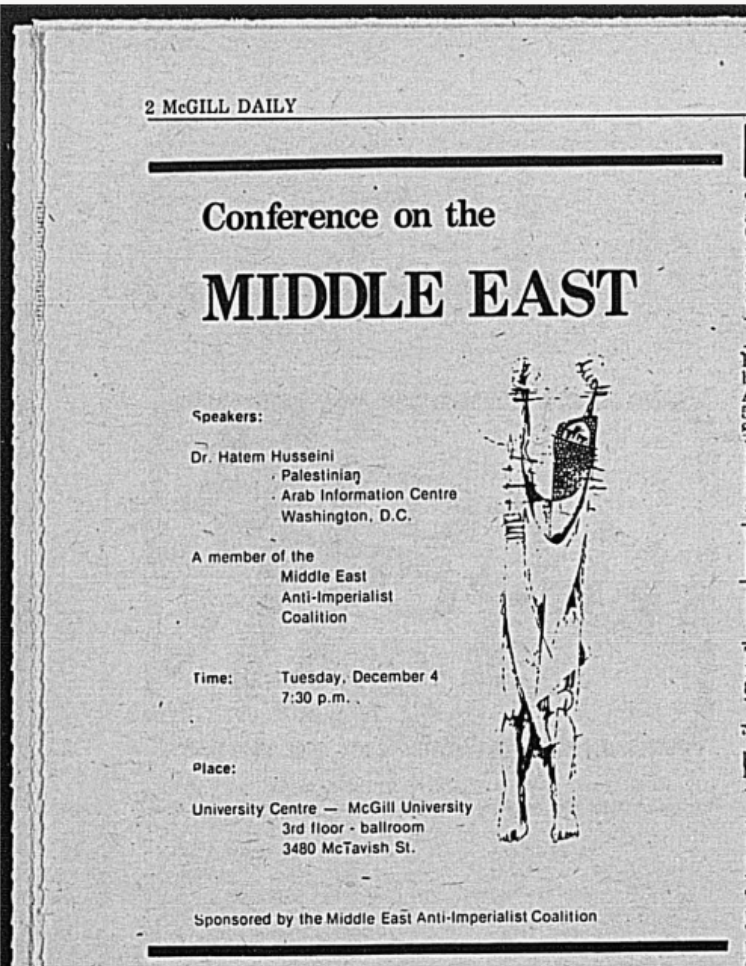
On December 4th a cover article by Linda Simmons announces the inaugural conference of the Middle East Anti-Imperialism Coalition, a group formed three weeks prior around the principles of “anti-imperialism, anti-Zionism, and support for the liberation struggles of the Palestinians and other peoples in the Middle East.” The Montreal coalition was not based at a university. It is described as being composed of “eight member groups as well as unaffiliated individual members” including teachers, students, and workers. Adjacent the article is a notice announcing a panel “discussion on the attack on campus democracy.”

Also published in the December 4th issue of the Daily, is a lengthy “open letter to the executive of the McGill Students’ Society and [perhaps?] the dean of students,” written by Professor of Anthropology, Peter C. W. Gutkind (p. 3). Gutkind is writing to express his serious concern about what he deems to be the abuse of civil rights in calling the police on campus. He claims to know and frequently debate members of the MSM and reminds readers that the university too “has had its own brand of political religion for a very long time” and has itself not always proceeded in “the most rational and intellectually rewarding manner.” Gutkind goes on to assert that “Radicalism is never rational in the eyes and minds of those prepared to live silently with injustices, racism and the exploitation of the many by the few,” and calls for the ban on any individuals or student groups to be lifted immediately.
Gutkind’s position was not shared by the Dean of Students he addressed. Not only was the students’ ban from the Union not lifted, Wallace, Ionis and Tansey were also placed on administrative suspension, with Wallace and Ionis barred from campus altogether (Dec 5, p. 4); and brought before the Senate Disciplinary Committee (Dec 14, cover).
The December 4th meeting to discuss repression on campus was attended by around 60 students with several campus leftist and labour groups represented as well as the Mouvement Révolutionnaire des Étudiants du Québec. According to an article published on December 5th, those in attendance agreed to organize around five demands: “end the attack on democratic rights,” end police involvement on campus and in student affairs, forbid the banning of students from the Union building, forbid the “denial or withdrawal of club status or access to campus facilities to political groups,” and drop the charges faced by MSM members. A student attendee from UQAM, John Leidjerman, emphasized how “university administrations use the police to crush student revolt” making it “‘absolutely necessary for students to settle their own affairs’ without police intervention.”
At this point, it seems that the story of the MSM is less about Palestine and anti-Zionism than about the MSM members specifically and in general, students’ rights to political free speech and association on campus. A December 7th article reports that Ionis has defied his ban from the Union yet again, to continue to hold MSM mass democracies on Zionism. While the article is about Ionis and his confrontation with the building manager—who “couldn’t bring [him]self to call the police again”—it concludes with a sobering quote from a Palestinian student who was “upset by the direction of the discussion” and expressed her criticism of “those political groups that use the suffering of my people for their own narrow factional purposes.”
An article reporting on the December 4th Middle East conference appears in the December 5th issue of the Daily. The conference was held at McGill and is described as well attended. PLO representative, speaker Rashid Hussein (misspelled as Housien), is quoted as having argued that the recent war had produced, for the first time in 25 years, a deep confidence among Arabs, and among Israelis, a loss of confidence in their government and “moral crisis” (cover). Hussein asserted his opposition to any religious state—“I want a democratic state in which all people can live” (p.4).
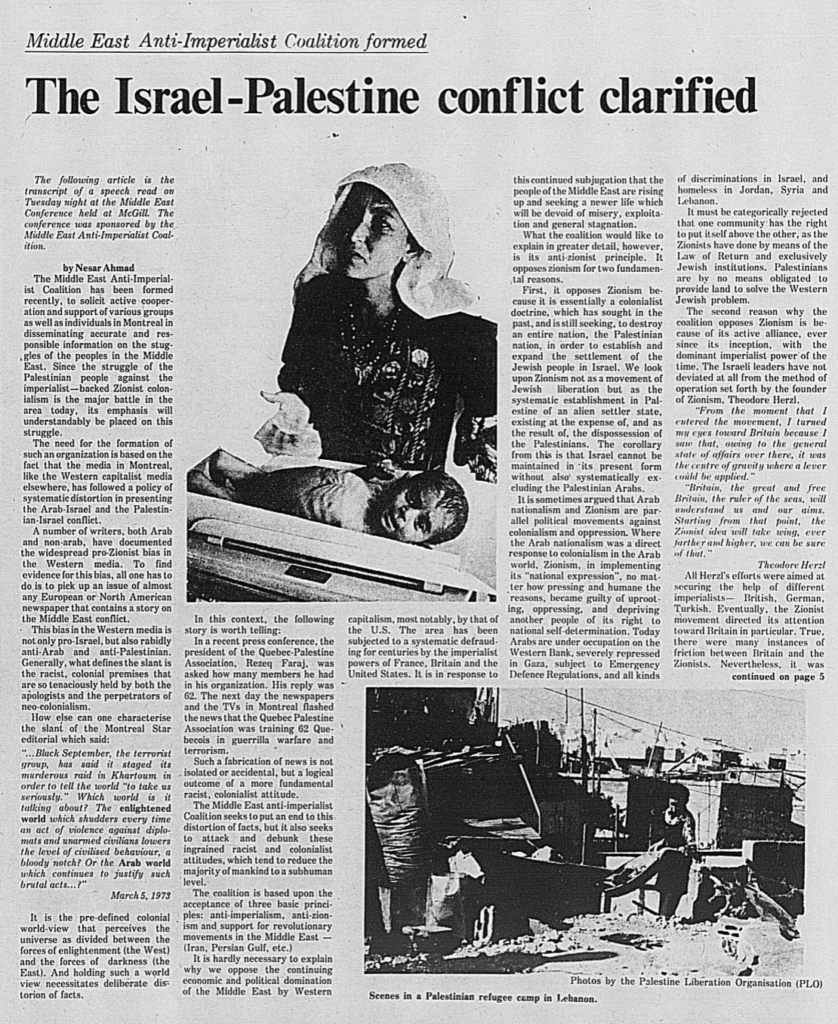
Nesar Ahmad, the previous editor-in chief of the Daily, also spoke at the conference, on behalf of the Middle East Anti-Imperialist Coalition. He identified the coalition as centring three core principles: “anti-imperialism, anti-Zionism, and support for revolutionary movements in the Middle East everywhere.” “Palestine is certainly not a country without a people” he continued, “The people are the Palestinians, whose right to self-determination we pledge to support.” The following day, December 6th, the Daily published Ahmad’s speech from the conference in its entirety (pp. 4-5), offering a historically grounded discussion explaining the importance of the Coalition’s politics.
Suggested citation
rosalind hampton, with Jose Miguel Esteban (2024). 1973: Palestine and the McGill Student Movement, part 2. Coalition Building on Campus. https://coalitionbuildingoncampus.ca/cboc-story/1973-palestine-and-the-mcgill-student-movement-part-2/