

1973: palestine and the mcgill Student Movement Part 1
During the late 1960s and early 70s the McGill Daily features regular event notices, letters and articles about Palestine and the Israeli state project, and documents ongoing debates about Zionism on campus. Nesar Ahmad was the editor-in-chief of the Daily from 1972-1973 and a graduate student of Philosophy and Islamic Studies from Pakistan.1 Ahmad had been writing articles for the Daily since 1970, on labour and anti-imperialist liberation movements. During the winter 1973 semester, several articles and letters published in the Daily speak to Ahmad’s support of the Palestinian struggle, and document the mounting critiques of Zionism within the McGill community.
A letter signed by Jan Weryho and published on February 13th describes Ahmad as having “with great courage supported the Palestinian cause” (p. 7). Weryho’s letter is about attending a film screening held by a group called Christian Fellowship and describes the feature as a “Zionist propaganda film designed for a Western Christian audience.” While at the event Weryho, who worked at the library at the Institute of Islamic Studies and identified as a Christian anarchist, was approached by student attendees and told to “accept Jesus as my saviour and the State of Israel as part of God’s plan.” Weryho writes that although they disagree with the young communists of the McGill Student Movement (MSM) on many points, it is MSM, not the Christian Fellowship, who are suffering “persecution at the hands of the Montreal police and McGill administration” in the pursuit of justice. “I would suggest,” writes Weryho “that MSM members with their readiness to sacrifice, and concern for the oppressed and suffering human beings (including the Palestinians) are more Christian than members of the Christian Fellowship with their indifference to human suffering.”
Two days later a reply is published by David Burrows, president of the Christian Fellowship. It seeks to “clear up some of the misunderstanding which our film seems to have caused,” and states that group members “deplore any of the violent, illegal tactics which the state of Israel may have used to deprive the Palestinians of their land just as strongly as we deplore the racist policies of the South African Churches.” Burrows asserts that it is “unfortunate in the extreme” that Palestinians and Israelis had been “unable to cooperate in the settlement of the land which could provide for both of them.” He adds that his group “does not deny the sacrifice and dedication of the members of the McGill Student Movement (Maoist),” but that they “disagree most strongly with their methods,” which he suggests are violent.
During that same week, an article by Andrea Kneeland describes a talk by Professor A. Meltzer of the Jewish Studies Department at McGill that had been held at Hillel House. Professor Meltzer is quoted as having argued for “survival first, morality second” as the basis for Israeli foreign policy. “U.S.-supplied phantom jets are ‘angels of life’ for Israel, Meltzer said, and Israeli foreign policies must court American approval at any cost.” Professor Meltzer also asserted that support for the white South African regime was in Israeli self-interest. The article describes him as having implied that “Israel must worry about Jews, not blacks” and that “Jewish interests in South Africa are white” (14 Feb 1973, p.3).
On February 27, 1973, Ahmad spoke at a forum “to discuss the Palestine question” held at Sir George Williams University and attended by about 70 students. An article by Linda Feldman published on the cover of the February 28th issue of the Daily reports Ahmad argued that peace in Palestine would require establishing a socialist state that would recognize all people in the area and would eliminate Zionism and the Israeli law of return. Ahmad is also described as strongly condemning “Arab reactionaries” seeking the removal of all Jews from Palestine as playing into the hands of Zionists. The article notes an atmosphere of tension and reaction and informs readers that “a student promoting the meeting was beaten up by 10 self-proclaimed Zionists earlier that day” and that the Jewish Defense League had threatened to disrupt the event. The other featured speaker at the event, McGill professor Raafat Jewely also spoke against the removal of Palestinians from their land and is quoted in Feldman’s article as having said that after 2000 years, “If you want to tell Palestinians to forget about their homeland—good luck!”

On March 2nd, the Daily announces another event, this time being held at McGill, and co-sponsored by the Quebec-Palestine Association, Middle East Solidarity Collective, and Mouvement Révolutionaire des Étudiants du Québec. The announcement comes at the conclusion of a lengthy, unsigned letter, asserting that while much is being said about “the Arab-Israeli conflict, […] the essence of the problem remains poorly understood.” The letter outlines the historical context since World War 1, describing the 1967 June War as having resulted in the “re-emergence of the Palestinians as vanguard of their own cause politically and militarily” and opening a “new page in the history of the entire Middle East” (p.4). The author asserts that despite the tactical victory of “the Imperialists and their allies” in 1970 by forcing the Resistance out of Jordan, “they in no way succeeded in their strategic aim of breaking the peoples’ struggle and will of the Palestinian masses.” The author identifies the only just outcome as “the creation of a democratic, secular, socialist state of Palestine’ (p.5). The conference was held that evening, and featured speakers U.S. professor of history Norton Mezvinsky and Québec labour leader and activist Michel Chartrand.
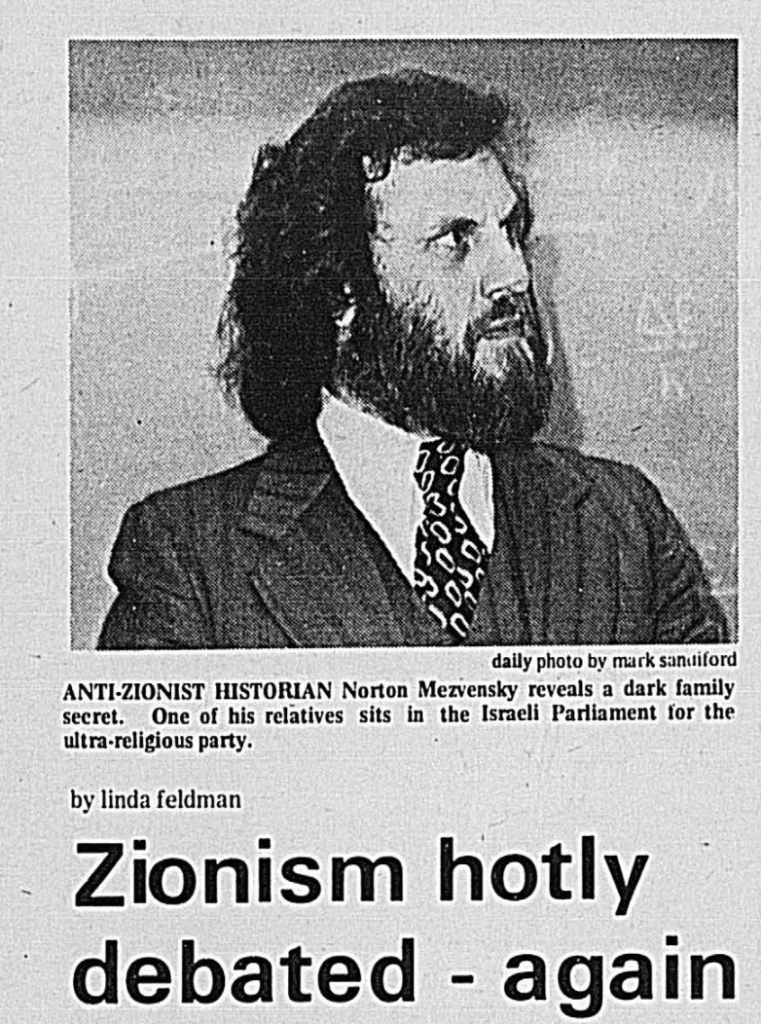
A cover article by Linda Feldman published in the 5 March 1973 issue of the Daily, reports that speaking at the event to an audience of 150, Mezvinsky (misspelled Mezvensky) argued that Zionism was “not a valid philosophical or theological expression of the Jewish religion” and that the only solution to the “Palestinian-Israeli conflict” was to “dezionize the State of Israel.” Chartrand had expressed explicit support for the Palestinian resistance and denounced Israel as “arrogant” and a “bad copy of the worst society in the world—the American.” He asserted that those running Israel were from Europe, and referring to Europeans, stated “we’re all a bunch of racists” (p. 4). A staunch critic of capitalism and imperialism, Chartrand noted that Israel treated Palestinians “the same way” the French had treated Algerians. He is quoted as having said, “We are a country of sophisticated colonials and slaves. Most of the underdeveloped countries are nearer solidarity, brotherhood and freedom than we are” (p.4); “Capitalism is fascism but we don’t have the nerve to face it” (p. 8).
Finally, an article by Ahmad appears on page 9 of the March 19th issue of the Daily, that condemns and places in broader context a Montreal Star editorial in which “the enlightened world” was distinguished from the “Arab world.” Ahmad also questions the tactics of the Black September Organization, referring to them as a “terrorist group” and suggesting they too leave intact such colonialist assumptions about a (civilized) Western vs. (barbaric) Arab world. The article troubles this dichotomy, explaining how it is a foundational distinction underlying Zionism and quoting its early proponents themselves. [Chaim] Weizmann, for example, had described the Zionists as “an educated peasantry and a skilled industrial class living on high standards” and Palestinians as “illiterate and impoverished communities bearing no resemblance to the Zionist community.”
Ahmad similarly reveals an explicit Zionist identification with European settler colonialism, quoting Ben-Gurion’s reflection in Rebirth and Destiny of Israel: “We were not just working—we were conquering, conquering, conquering a land. We were a company of conquistadores.”
Suggested citation
rosalind hampton, with Jose Miguel Esteban (2024). 1973: Palestine and the McGill Student Movement, part 1. Coalition Building on Campus. https://coalitionbuildingoncampus.ca/cboc-story/1973-palestine-and-the-mcgill-student-movement-part-1/