
1970s Anti-Apartheid Organizing at McGill University
Theme: Anti-Apartheid Organizing
Student anti-apartheid organizing at McGill University can lay claim to a victory—it was the first university in Canada to announce its divestment in companies with ties to South Africa. Today, its official website makes this claim proudly in a section titled, “Black at McGill,” dedicated to the experiences of Black people on campus. The website’s narration of this features the front page of the McGill Daily on November 18, 1965.
Our story of Black student anti-Apartheid organizing on campus also is built from the McGill Daily but offers more nuance. Exploring the student newspaper’s coverage of and engagement with activism and organizing against apartheid reveals a complex situation, including how Black students on this campus worked together and in coalition with other students and groups. Our story goes beyond front-page headlines, their accompanying stories, and triumphant notes, delving more deeply into editorials, letters to the editor, commentaries, short pieces called “Hyde Park” where people offer opinions, images, inset quotations and more.
chapters
One story of anti-apartheid organizing at McGill builds from two short articles published on December 3 and December 10, 1971, in the McGill Daily and two small inset advertisements published on December 2, 1971. The first is a short piece with no author attached, titled, “Cecil Rhodes is Dead” (p. 5) (Figure 1). This short, descriptive column outlines the activities planned for the upcoming Week of Solidarity with the Zimbabwean People, organized by what it refers to as “various black groups at McGill, Sir George, and the community at large.”
The article discusses a visiting speaker, teach-in, and other activities protesting the agreement between the British government and the white Smith regime of “Rhodesia” effectively supporting white rule in Southern Africa.


One week later a second article by Andrew Philips appears titled, “100 Protest British Sell-Out” (p. 3 continued p. 5) (Figure 2), which focuses on the demonstration organized by a coalition of people in Montreal, including students at McGill, which began at the student union and marched down Sherbrooke and University streets to the British Trade Commission.
On December 2 of the same year, two small square announcements appeared on the back pages, labelled “African Students Association,” one as a “today” reminder (Figure 3) and the other as a classified ad, listing the time and place for a teach-in about the “racist British sell out in Rhodesia” (Figure 4).
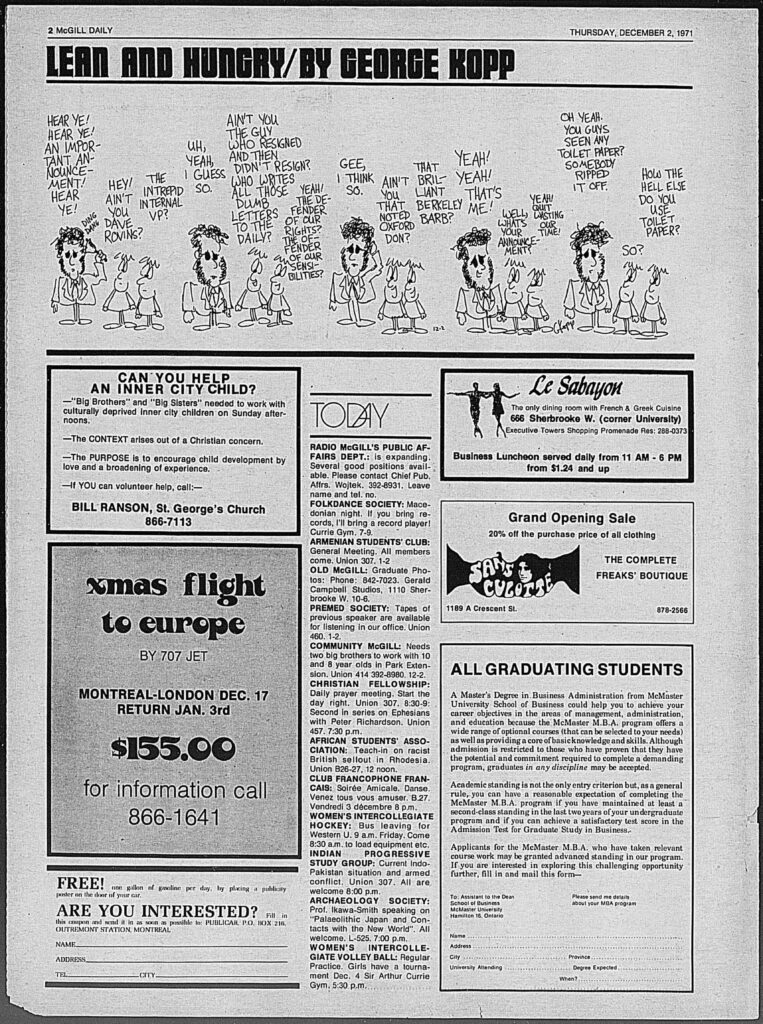

Coalition around fighting apartheid and Southern African politics
“African Students” appear in the Daily throughout the 1960s and early 1970s in a variety of contexts including doing work on education and consciousness raising about the African continent and politics there. Different struggles, including decolonization, are documented and charted in these pages. The story of organizing by African students in coalition with other students against apartheid South Africa as well as the racist Southern African governing systems in other countries does not appear in a linear narrative. Moreover, in the McGill Daily this work is later eclipsed by the McGill South Africa Committee which is formed in the 1980s and later the work of the Black Students Network.
A story can be formed however by reading some of the details presented in these stories. First of all, the African Students Association is active throughout the 1960s and 1970s and took out classified advertisements for the activities in the student newspaper, as well as these events appearing in lists of announcements and having articles written about them. Other details can be drawn out of these reports as well, by closely reading the articles.
Important to building a story about organizing by Black students is the way that the Andrew Philips reports that the demonstration was put together by what he labels an “African coalition.” He states that it represents the “black population of Montreal” and goes on to say that it includes, “African Students Society and the Black Students’ Union of McGill, the Black Students’ Society of the Université de Montréal and the Afro-Asian-Latin American Peoples’ Solidarity Movement.”
While all of these groups do appear in the McGill Daily, they are mentioned relatively infrequently. It is even less frequent to see these groups reported on in relation to each other, and we have not located further explicit documentation of their coalition.We highlight this in our story here because the history of formations like the African Students Society and the other groups mentioned are often lost, as are stories of their coalition/s. Drawing attention to this co-organized demonstration, therefore, is all the more important in the larger story of anti-apartheid organizing.
An important detail to draw out of this story of coalition is that the coalition is between Black groups at McGill, another at Université de Montréal, and another People’s Solidarity Movement that is not defined as belonging to a university at all. Moreover, the coalition is described as “representing the black population Montreal” and therefore suggests a community-university cooperation that is larger than just campus-based organizing.
The language of the article presents other details as well. For example, it states that the demonstration is the “latest action by a coalition of African and other minority groups protesting the agreement, which will lead to the official granting of Rhodesia’s independence from Britain without changing the country’s present political structure.” This small phrase “the latest action” is imprecise and cannot tell us in any detail how many others there may have been. But a story of coalitional organizing by Black students might imagine that this is not a unique or one-off experience and helps us to date anti-apartheid organizing by Black students of different backgrounds with each other and with others, at least as far back as the 1970s.
Suggested citation
Michelle Hartman (2023). 1970s anti-apartheid organizing at McGill University. Coalition Building on Campus. https://coalitionbuildingoncampus.ca/cboc-story/1970s-anti-apartheid-organizing-at-mcgill-university/