
1970: A Varsity Editor Reports Back Part 2
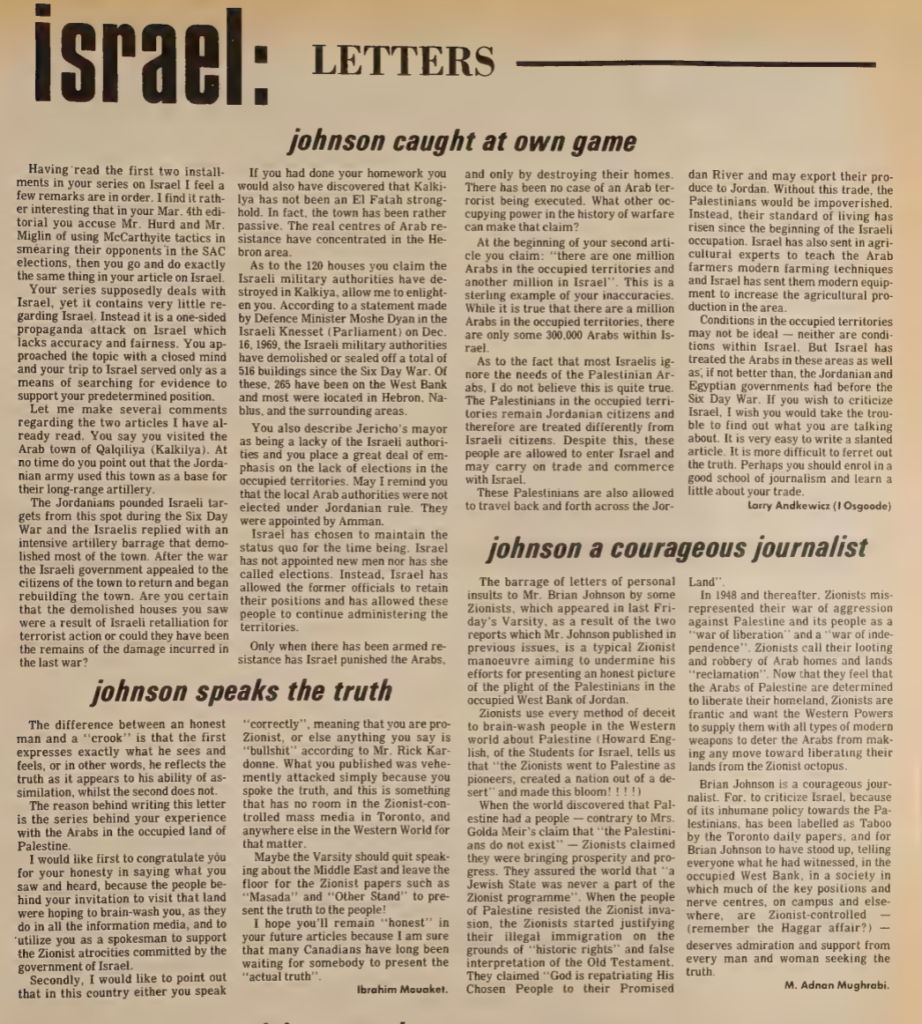
On March 11th, two full pages of letters responding to Johnson’s articles appear in the Varsity (pp. 5-6). On page 5, two letters accuse Johnson of “anti-Israeli bias” and of approaching his trip with a “closed mind” and “predetermined position.” The writers dispute many of the claims made in the first two articles and particularly insist that there are hundreds of thousand fewer Arabs under Israeli rule than the two million Johnson had claimed. Both suggest that Israel has in fact improved the lives of Palestinians in the region, once again referring to them with the general term, “Arabs”: “Israel has treated the Arabs in these areas as well as, if not better than, the Jordanian and Egyptian governments had before the Six Day War” (Andkewicz, p.5). The other two letters on the page express support for Johnson, one of which states that longstanding Zionist claims to be “bringing prosperity and progress” to the region, and to be engaged in a “war of liberation” and “war of independence” (Mughrabi, p.5). These letter writers congratulate Johnson for his honesty and courage, “because the people behind your invitation were hoping to brainwash you, as they do in all the information media, and to utilize you as a spokesman to support the Zionist atrocities committed by the government of Israel” (Mouaket, p. 5). They argue that Johnson has been attacked because he has written the truth, which “has no room in the Zionist-controlled mass media in Toronto and anywhere else in the Western world for that matter” (Mouaket, p. 5).
The next page features three more letters, all supportive of Johnson’s series. Nicolas Zabaneh of the U of T Student Arab Movement notes that “We, the Palestinian people in the University of Toronto, did not hasten to write praising Mr. Johnson, for Mr. Johnson wrote the truth. He is to be thanked for his braveness in writing the truth in a university full of innocent Jews mislead by the forces of Zionism” (March 11, p.6). Zabaneh reminds critics who accuse Johnson of Arab propaganda, that it was the Israeli state that invited Johnson and others to Israel with the intention that they would write Israeli propaganda. “I was there 11 months ago” writes Zabaneh, “and when I left, nine of my personal friends were in jail for political reasons—resistance to occupation. These were students of Berzeit College, the highest student institution in Palestine. They were jailed for six months, put on probation for two years and fined I.L. 1000 ($300) because they peacefully demonstrated in from of Israeli headquarters at Ramallah, 11 miles north of Jerusalem” (p.6). Also on this page, a brief letter from a “Canadian Jew” challenges accusations that Johnson is antisemitic for “exposing Israel’s expansionism and Nazism.” The writer asserts their love for their fellow Jews, “including those in Israel,” while raising the question of whether they are an antisemite because they “despise Israel as a nation” (Gould, p. 6).

A letter from another anti-Zionist Jew is published on page 4, a more extensive commentary asserting 11 key claims. These include that “Israel is not a socialist society, it is state-capitalist,” and that “the ‘religious’ foundation of the State of Israel is racist. It is the racism of an historically oppressed people, but it is still racist” (p.4, emphasis in original). The author, Andy Wernick, declares his support for “popular movements in the Middle East to smash the State of Israel” while rejecting “any kind of race war waged against Jews as such” and opposing the Arab nationalist movements encouraged by nationalist governments “in order to divert their people from revolution at home.” Echoing the Black Power Movement of the time, Wernick concludes his letter with the call, “ALL POWER TO THE PEOPLE” (March 11, p.4). In a subsequent response to letters attacking his position, Wernick replies simply,
(1) You don’t combat anti-semitism by supporting the oppression of another Semitic group.
(2) Some blacks say “kill whitey”: they have got things wrong. That does not turn me into an opponent of an autonomous black struggle for liberation. In such a case I would be a racist. (March 13, p. 21)
The third and final article in Johnson’s series also appears in this March 11th issue and addresses the lives of Israeli youth as they are shaped by the kibbutzim and university systems amidst the ever-presence of war. Johnson describes the visiting editors’ tours of University of Tel Aviv, Technion, and Hebrew University, where they “saw familiar structures that related directly to the proverbial military-industrial complex. Just like in North America” (p.10). He quotes a student he spoke to at Technion who explains that: “Our situation does not allow us to be very humanistic, because of the threat we face.” Johnson describes Israeli students as “serious,” most having served in the army after high school; “at the Technion,” he writes, “‘political activity’ is forbidden by the Council of Students.
“We don’t have any riots here,” another student explained. “We are not like the French students; we are not amateurs. We have been in the army and we are soldiers. Most of the faculty are officers and sergeants. So if we have a riot, it will be a good one” (March 11, p.10).
An American professor at Hebrew University underscores that the Israeli students are “better integrated in society” and do not “have time to sit around and form a subculture.” Johnson notes the students did not understand U.S. students’ resistance to the military draft, as well as their different conception of “student power” which they saw as “a device to make university run more smoothly, not to restructure the function of education.” The only disruption at the universities, noted Johnson, “results from isolated acts of Arab terrorism,” citing a previous incident in which a bomb had been carried into the cafeteria of Hebrew University.
Rather than the overt political propaganda Johnson and his colleagues expected to encounter on the tour, Johnson recounts that “the present Middle East conflict was deemphasized as we were heavily bombarded by the history of Masada, the beauty of Eilat, the architecture of Jerusalem” (p. 11). Tourism, he continues, is thus a “subtle and effective method of propaganda itself” as it becomes easy to associate the beauty, history, and archaeology of the country with the idea that it is “playing a just role in the Middle East” (March 11, p.11).

Johnson also notes pervasive American influences throughout Israel, including American textbooks, professors, “university construction financed with private American capital,” discotheques and Coca Cola signs. He describes tourism as “the most powerful American presence” of all, providing “the second largest source of revenue” (p.10). Johnson quotes the Israeli Tourism Minister as having characterized his relation to US capital as “giving out loans to American investors to build American hotels for American tourists” (p. 11); and they had invited the editors to their country “to build bridges between the youth of Israel and the youth of North America” (p. 11).
Johnson goes on to explain visiting a kibbutz, and how the kibbutz is the centre of Israeli political development via the youth. He describes the kibbutzim as functioning as “mini-utopias” of agricultural production and socialist organization characterized by “no private property and little management hierarchy” (p.11). He adds, however, that the kibbutz nevertheless “plugs neatly into a state capitalist economy. The camps provide a very cheap supply of labour, and the socialist politics do not extend beyond the structure of the kibbutz” (p.11). Johnson explains that drugs like marijuana are discouraged and unwelcome because, he was told, Israeli youth aren’t bored and do not need escapism. “In Israel there is no escape” writes Johnson, “No alternative to nationalism. Things never get boring when there’s a war going on” (March 11, p.11).
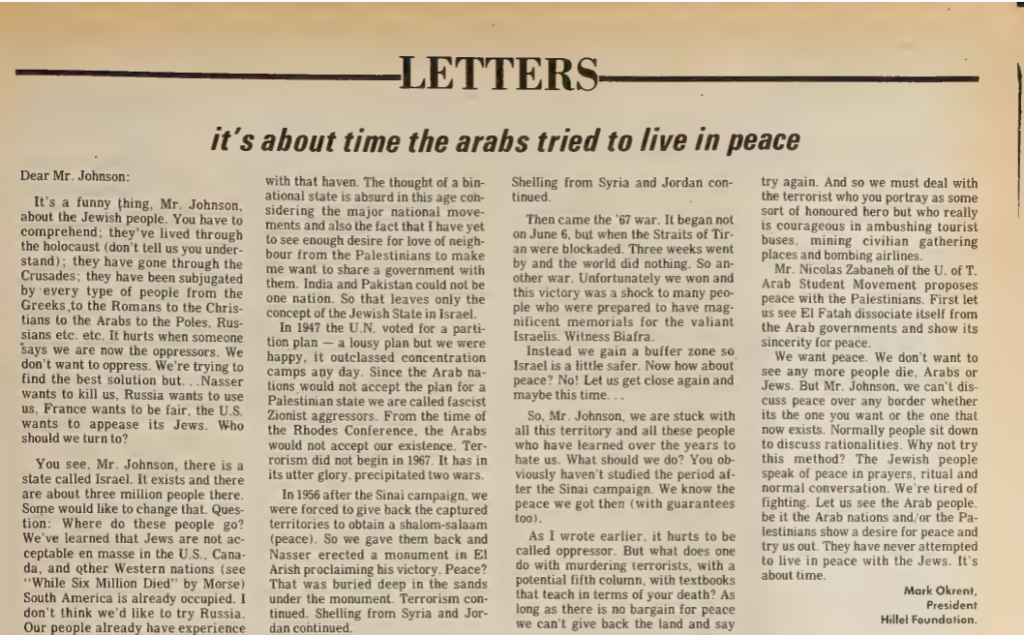
The letters and debate about the Palestinian continue through the end of the semester. In the “last regular issue” of the Varsity of the academic year, March 18th, a half-page announcement by the Student-Faculty committee for Judaic Studies and Hillel Foundation published on page 2 describes plans for expanding Judaic Studies at the university. A long letter to Brian Johnson from Mark Okrent, President of the Hillel Foundation appears on page 5, and an excerpt from a letter from an Israeli born university student in Jerusalem, written to his course studying at U of T. The letter describes Israeli military activity, while insisting Israelis want peace. “Well, you see, when you are in the cold and rain instead of a heated apartment you want peace desperately and this is also one of the many viewpoints you can look on in the conflict. (I’m sure from this viewpoint the Arab soldiers want peace much more than we do.)” (Erlich, March 18, 1970, p. 6). This appears to have concluded the public exchanges on Palestine for the year, with the paper “still left with a pile of letters on Israel” that had not been published “for reasons of space” (March 18, p. 5). There are a few special issues of the newspaper published over the next few weeks, however discussion of Palestine or Israel is not featured in these. A piece by Andy Wernick (March 18, pp. 14-15) summarizes the year in global politics, concluding in part,
U of T still functions as an imperialist institution — housing reactionary ideologues…; it does research and development for U.S. Corporations, the military and the Government (which is not neutral); and it manipulates us into being manipulators (social scientists), unproductive decadents (pure arts) and technical workers who are sold on a career and power myth (technical sciences).
All this is a familiar leftist litany: but we reproduce this institution every day of our lives.
What are we going to do?
Organize.
Suggested citation
rosalind hampton (2024). 1970: A Varsity reporter reports back, part 2. Coalition Building on Campus. https://coalitionbuildingoncampus.ca/cboc-story/1970-a-varsity-editor-reports-back-part-2/