
1993: anti-racist action and coalition-building across toronto (pt. 2)
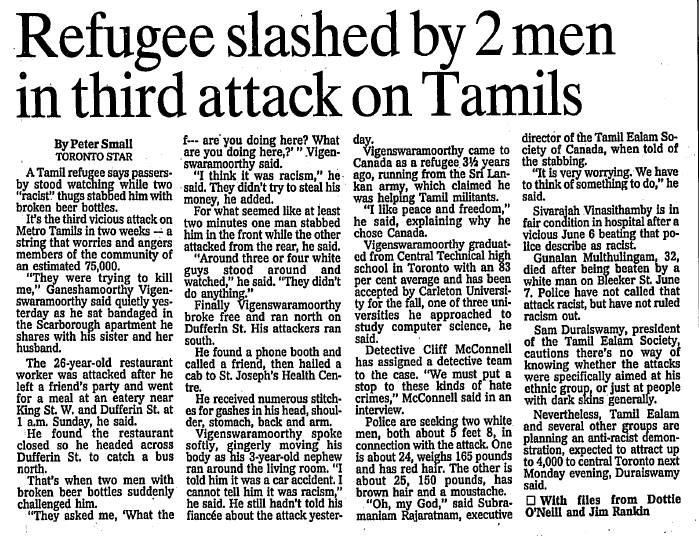
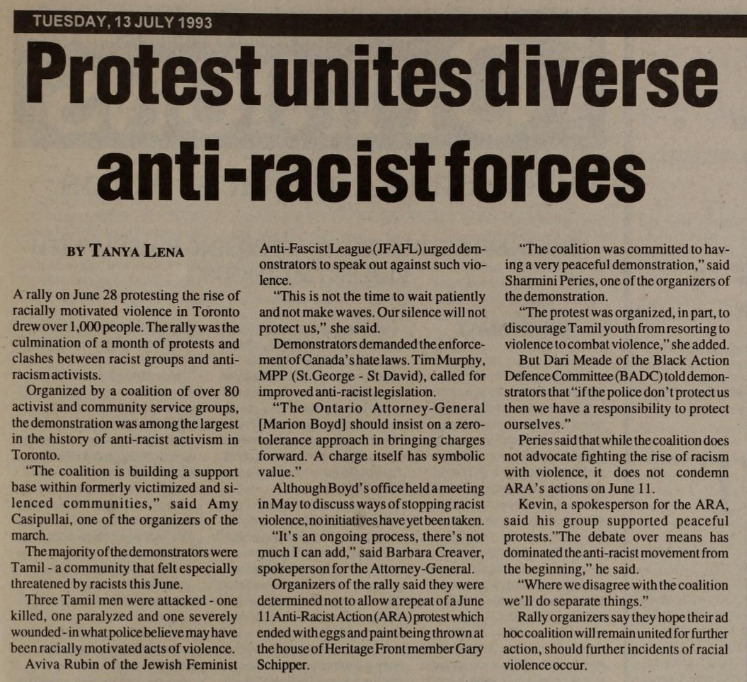
On June 20th, 1993, Ganeshamoorthy Vigneshwaramoorthy, a 26-year-old Tamil refugee and restaurant worker was attacked by white supremacists on his way home from a night shift. Assailants struck him with beer bottles across his head, shoulders, stomach, back, and arms, leaving him with stitches across his body. In a June 22nd article for The Toronto Star, journalist Peter Small interviewed Vigenshwaramoorthy, who recalled two white men repeatedly demanding: him “What the f___ are you doing here? What are you doing here?” In the weeks that followed, student journalists in The Varsity document the large-scale anti-racist student mobilizing across the University of Toronto that erupts in response to Vigneshwaramoorthy’s assault. Articles discuss the actions of ARA-TO members and document the many student-led organizations that came together to resist white supremacist violence. In one such article, “Protest unites anti-racist forces,” reporter Tanya Lena documents the work of Toronto Coalition Against Racism (TCAR), a coalition of over 80 activist and community service groups that organized a rally on July 22nd and drew over 2000 people to the streets. Amy Casipullai, one of the organizers of the march, reflects on the purpose of cross-group mobilizing as an effort to “build a support base within formerly victimized and silenced communities.”
Lena’s article in The Varsity includes more quotes from the organizers of the UofT rally, including Nadu Guna from the Tamil Eelam Students Association who shares that “the protest was organized, in part, to discourage Tamil youth from resorting to violence to combat violence.” Guna’s quote appears right beside a quote provided from a speech delivered by Dari Meade of the Black Action Defense Committee (BADC) reminding demonstrators that “if the police don’t protect us then we have a responsibility to protect ourselves.” Both speeches were delivered at the same protest and reveal the diversity of tactics, knowledge, and responsibilities present in a single rally.
Schwartz’s (2024) notes the role of young Tamils in this organizing. An activist named Mary from TCAR, for example, reflects on the many people in the Tamil community who did not hesitate to support the coalition’s work because “a lot of people had been actively involved in the war, and fleeing the war, and there was a lot of organizing skills there.” Mary continues to emphasize how organizing against the far-right “had to be seen in the broader framework of racism in the system that creates and reproduces racism.” This meant that the coalition needed to be led by communities targeted by fascists in order to build the strength and power necessary to “drive the fascists back into their little slimy holes.” It is difficult to ascertain whether there was any meaningful engagement with the “organizing skills” among young Tamil students, as Schwartz’s thesis does not go beyond this mere recognition.
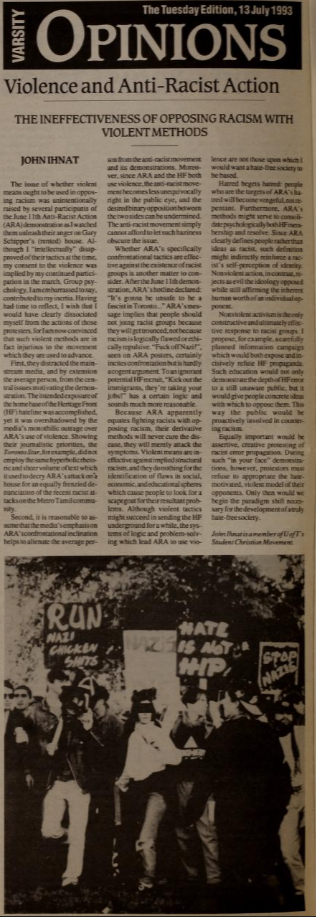
Mary’s interview with Schwartz, published nearly 31 years after the rally, signifies an attempt to deepen TCAR’s approach to coalition-building beyond loose comparisons of “violent” and “non-violent methods.” Articles in The Varsity struggle to capture this nuance as writers continue to denounce the use of violence to combat rising tides of organized white supremacy. An opinion piece published for the newspaper’s July 13th, 1993 edition condemns ARA’s actions, arguing that “[n]onviolent activism is the only constructive and ultimately effective response to racist groups.” The opinion piece suggests educational interventions and asserts that resistance against white supremacy must not reproduce the violent tactics of the neo-nazi group but instead be focused on tackling ideology. Kevin, a spokesperson for Anti-Racist Action Toronto (ARA-TO) notes how the debate over tactics continued to dominate reporting about the June 11th direct-action at Schipper’s house and the subsequent June 22nd rally at UofT. While ARA-TO disagreed with the TCAR on the choice to frame their rally as “peaceful” and “non-violent,” Kevin emphasizes that both organizations were able to work together and “do separate things.” Even through these disagreements, no organization came forward to condemn earlier ARA-TO actions that employed more direct-action strategies.
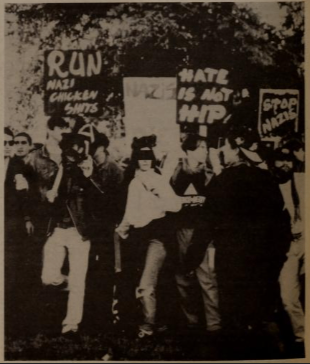
Student journalists in The Varsity note how organizers of ARA-TO’s June 11th rally deliberately redirected demonstrators to Gary Schipper’s house. While the mobilization was called in response to organized white supremacist violence that attacked and killed Tamil men, the direct action on Heritage Front’s radio station provided an opportune occasion for ARA to pursue its goal of amplifying calls from several Indigenous groups to shut the station down. And they didn’t back down. In the weeks following June 1993, ARA-TO continued to release messages to the public on their own hotline, warning listeners that “[i]t’s gonna be unsafe to be a fascist in Toronto.”
This story of coalition-building reflects the necessity of pulling scholar-activist and student-journalist writing together, including articles from The Varsity, UofT student theses, and articles published in The Toronto Star. In 1993, anti-racist actions brought together movements from across the city, including student groups, labor movements, and community-based organizations, against the rise of organized white supremacy. Many of these demonstrations heightened following three separate violent racist attacks against Tamil men in June 1993. Student journalism and research produced by student-activists demonstrate that Tamil youth understood the connections between what their communities were experiencing and the broader struggle against the far right. Coalitions that made large-scale demonstrations possible in 1993 occurred because of the efforts of youth to engage in the messy work of building relationships around a shared responsibility to protect one another. These coalitions were not without their contradictions, as evidenced in reporting throughout The Varsity, which highlights how principles and strategies to combat structural and institutional violence were refined at a period when thousands took to the streets.
Sources
Schwartz, K. (2024). Toronto’s Anti-Racist Action, 1992-2003: “Expose, Oppose and Confront.” [Master’s thesis, University of Toronto]. TSpace. https://utoronto.scholaris.ca/server/api/core/bitstreams/51688696-3e2a-49d6-a6bf-799859d374e5/content
The Varsity, June 8, 1993 – April 12, 1994 https://archive.org/details/thevarsity114/page/n75/mode/2up
Toronto Star, June 22 1993, https://www.proquest.com/hnptorontostar/newspapers/page-a6/docview/1370515376/sem-2?accountid=14771
Vigneswaramoorthy, V. (2024). After I Go, I Will Come Back: Imagining Tamil Community in the Contexts of Solidarity and Decolonization. [Master’s thesis, University of Toronto]. TSpace. https://utoronto.scholaris.ca/server/api/core/bitstreams/88e66063-5efc-4936-a501-8e894f866cd3/content
Suggested citation
Abarna Selvarajah (2026). Anti-Racist Action and Coalition-building across Toronto, part 2. Coalition Building on Campus. https://coalitionbuildingoncampus.ca/cboc-story/1993-anti-racist-action-part-2/